Showing posts with label barabara classic. Show all posts

Apr 4, 2012

Maulawi


dusted mag sez:
…an absolute original that flies in the same circles as some of the greatest jazz and soul records of the early '70s. Maulawi Nururdin's Maulawi covers a staggering landscape, and does a virtual Sherman's March across the territories of funk, blues, post-Palladium latin jazz, samba, and his own unique take on the outtasphere; burning it all down with punishing resolve, and reviving it all in his own image. Maulawi, Nururdin's solo album that died a commercial death shortly after its 1974 release, reveals a palette of compositional depth and sonic intelligence that Nururdin would have had a tough time topping had he recorded again. The product of an era rife with social and political tension, this work highlights a street-hot assembly of musicians as they document their composer/bandleader's detailed, colloquial vision.

barabara sounds sez:
Spiritual but gritty, hip, compelling and percussive, Maulawi is (as Dusted points out) something like a cross between Miles (Evil Live era) and Curtis at his Chi-town funkiest. Intrigued? You should be. If you've never heard this lost-classic one-of-a-grooving-kind album — originally on the Strata label but reissued on Universal Sound — then you're in for a major treat. Enjoy it while you can. 

tracks:
Street rap; Root In 7/4 plus; Eltition; Naima; Sphynx rabbit.


Mar 4, 2012

Archie Shepp - Yasmina, a black woman


barabara sounds sez:
It doesn't get much better than this all-time classic: Archie Shepp and his band invoking the spirits of Africa and the avant guard, a massive collaboration with the key members of the Art Ensemble of Chicago. Brilliant stuff and, needless to say, a barabara classic.

dusty groove sez:
Archie Shepp at his spiritual best – recording in Paris in 1969, and absorbing a heck of a lot of pan-African influences! The centerpiece of the album is the amazing "Yasmina" – a long track that builds with passion and fire, pulsing with an intensity that you'd expect more from Pharoah Sanders than Shepp himself. Next up is "Sonny's Back", a wonderful straight jazz groover with Archie and Hank Mobley on twin tenors upfront – making a rare and memorable recorded appearance together! The set's capped off by a mellow version of "Body & Soul", one that points towards the more soulful side of Shepp's work in the 70s.

personnel:
Archie Shepp vocals, soprano & tenor sax, piano; Roscoe Mitchell bass sax; Grachan Moncur III trombone; Dave Burrell piano; Burton Greene piano; Laurence Devereaux balafon; Sunny Murray drums, percussion; Claude Delcloo drums; Hank Mobley vocals tenor sax; Lester Bowie trumpet; Clifford Thornton cornet; Philly Joe Jones drums.

tracks:
A1 Yasmina; B1 Sonny's Back; B2 Body & Soul


Oct 26, 2011

Pharoah Sanders - Journey to the One + Rejoice


barabara sounds sez:
The great great Ferrell just finished the second of a two-night stand here. So, in honor and awe, here's a couple of his finest mid-period sides on the Theresa label. Rejoice is of course a bonafide barabara classic – just look and marvel at the outstanding line-up of musicians he has with him here – and without question cause for outright exultation.

As for Journey to the One, it's a bit of a cosmic cocktail of textures – from spiritual-jazz anthems and all-out trademark Pharoa-nics to ballads, and using koto, sitar, synths and more – but there are plenty of special moments here, not least the stately magnificent Bedria that closes out side 4. One of my favorites, in fact...


dusty sez (on Rejoice):
Fantastic 80s work from Pharoah Sanders – with a vibe that's a perfect extension of his classic work for the Impulse label! The album has Pharoah working with an amazing group – Bobby Hutcherson on vibes, John Hicks and Joe Bonner on piano, Art Davis on bass, and either Elvin Jones or Billy Higgins on drums. The sound is remarkably fresh – soaring and spiritual, but also more focused than in earlier years, with a great amount of soulful warmth. And although extra elements are added – like vocals, vibes, and added percussion – Pharoah's solos still dominate the whole album beautifully.  

amg (Scott Yanow) sez (on Journey):
…all ten of Pharoah Sanders's performances from the sessions. As usual, Sanders shifts between spiritual peace and violent outbursts in his tenor solos. The backup group changes from track to track but often includes pianist John Hicks, bassist Ray Drummond and drummer Idris Muhammad. Sanders really recalls his former boss John Coltrane on "After the Rain" (taken as a duet with pianist Joe Bonner) and a romantic "Easy to Remember"; other highpoints include "You've Got to Have Freedom" (which has Bobby McFerrin as one of the background singers) and the exotic "Kazuko" on which Sanders is accompanied by koto, harmonium and wind chimes.

Jul 4, 2011

Toshiyuki Miyama and his New Herd - Orchestrane

barabara sounds sez:

New Herd Play John Coltrane: the album subtitle is all you need to know. And it's big, bad, big-band brilliance. Just look at that line-up; four trumpets, four trombones, five saxes. Fasten your seat belt and hang on for the ride!

The three numbers on side one warm you up nicely, mixing some fine modal soloing with slick-smooth ensemble playing on those classic compositions. And then you're ready for side two: all four parts of A Love Supreme like you've never heard them before. Yamaki's charts are just superb. This is probably the best thing Miyama ever recorded with his New Herd. It's certainly one of my favorites – if only for that beautiful cover art. Bottom line: it's a barabara classic!

musicians:
Miyama Toshiyuki leader/conductor; Yamaki Kozaburo guitar/arranger; Takeda Kazumi 1st tp; Kishi Yoshikazu 2nd tp; Yamaguchi Kojiro 3rd tp; Kamimori Shigeru: 4th tp; Kataoka Teruhiko 1st tb; Uetaka Masamichi 2nd tb; Shiomura Osamu 3rd tb; Fukushima Teruo btb; Suzuki Koji 1st as; Shirai Atsuo 2nd as; Mori Mamoru 1st ts; Nukita Shigeo 2nd ts; Tada Kenich bs; Takano Kiyoshi p; Fukushima Yasushi b; Nakamura Yoshio dr.

tracks:
1. Impressions; 2. Naima; 3. Giant Steps;
4. A Love Supreme i) Acknowledgement; ii) Resolution; iii. Pursuance; iv) Psalm

rec. Mar/Apr. 1977; issued Denon YX-7566-ND; CD reissue 2005

Jan 3, 2011

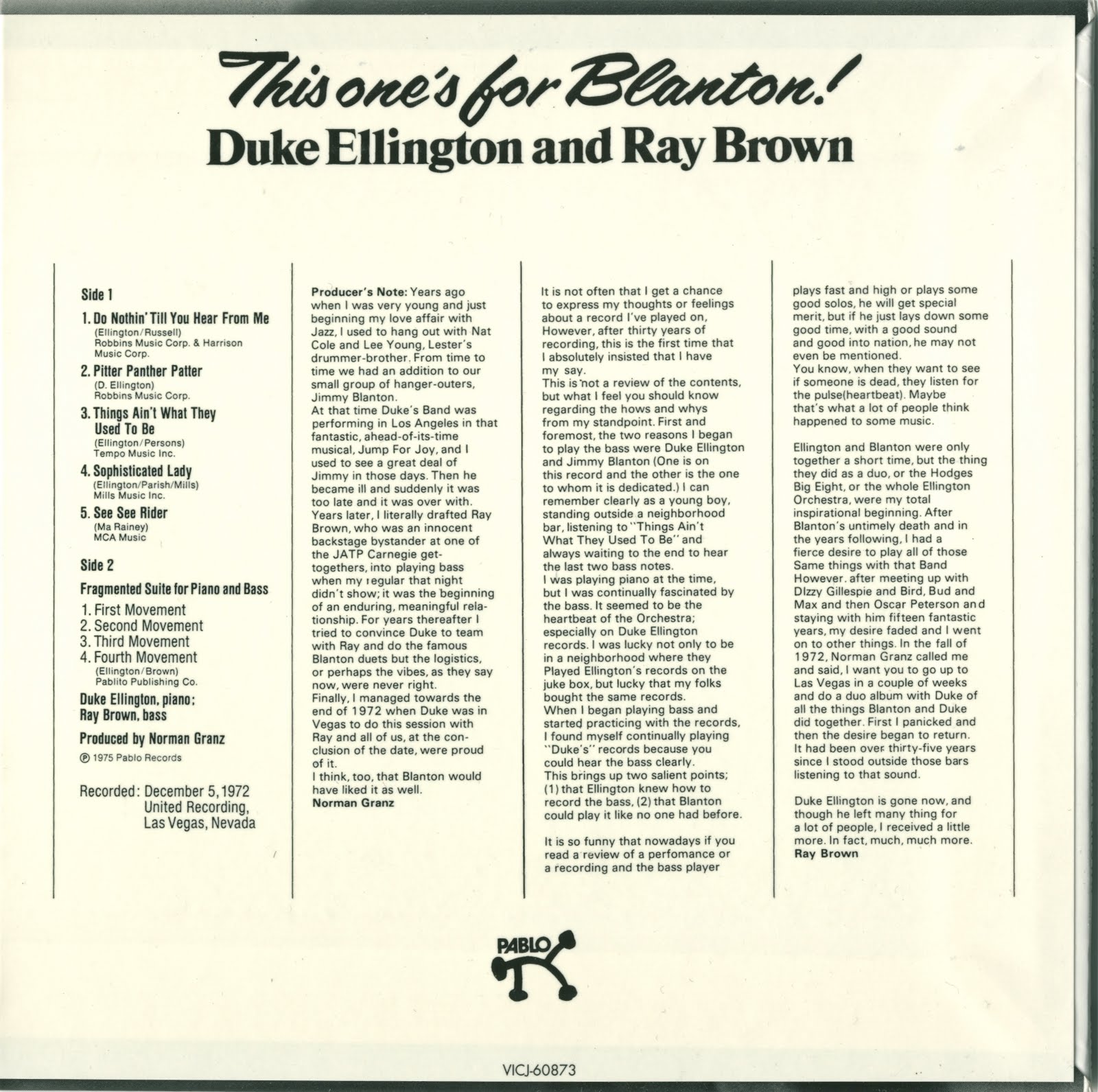
Duke Ellington and Ray Brown - This one's for Blanton!

barabara sounds sez:
It doesn't get much simpler than this: just piano and bass. But there is so much music here, with Ellington and Brown just hitting the perfect groove. I love the de/reconstructed See See Rider. But it's the second side that really does it for me, the four-part Fragmented Suite for Piano and bass. This was just about the last session Duke ever recorded. And I've got to say, it's one of the most beautiful I've ever heard of his. Not that I've heard them all — in fact one of my new year resolutions is to listen to a lot more of the older albums Ellington did in the 50s and beyond. This is from the JP reissue of the Pablo album, and it's a bona fide barabara classic.

From the sleeve notes by Ray Brown:
Ellington and Blanton were only together a short time, but the thing they did as a duo, or as the Hodges Big Eight, or the whole Ellington Orchestra, were my total inspirational beginning. After Blanton's untimely death and in the years following, I had a fierce desire to play all of those same things with that band. However... I went on to other things. In the fall of 1972, Norman Granz called me and said, I want you to go up to Las Vegas in a couple of weeks and do a duo album with Duke of all the things that Blanton and Duke did together. First I panicked and then the desire began to return. It had been over thirty-five years since I stood outside those bars listening to that sound. Duke Ellington is gone now, and though he left many things for a lot of people, I received a little more. In fact, much much more.

When he died in 1942, Duke Ellington’s 21-year-old bassist, Jimmy Blanton, had liberated the string bass from its traditional role as an accompanist. Two of Blanton’s disciples, Ray Brown and Oscar Pettiford, carried forward his work of developing the bass into a solo instrument. Their contributions had a great deal to do with bebop’s becoming a mature music. More than 30 years after Blanton’s death, Brown went into a studio with Ellington to pay homage to his idol. Their duets echo the famous ones of Ellington and Blanton and demonstrate Brown’s creativity and virtuosity on the Blanton model.

If you like this, then check out Reza's post of the Ellington suites, also on Pablo... highly recommended!

Aug 23, 2010

The Dave Pike Set - Noisy Silence Gentle Noise

barabara sounds sez:

A lot of people rate the early work by Dave Pike, but for me it's the MPS era that I listen to. Especially this album. The track everyone knows is Mathar, classic sitar jazz courtesy of sidekick Volker Kriegel. But there's also a lot of excellent vibes/guitar interaction throughout, like on the title track. Great vibes, in both/all senses of the word. Did I say classic? Yes, well maybe it is...


amazon sez:

Pike's move to Europe and tenure at MPS/Saba records produced some of the most original jazz of the period. With the collaboration of Voker Kriegel (guitar), J.A. Rettenbacher (acoustic and electric bass), and Peter Baumeister (drums), he formed the Dave Pike Set. The group recorded 6 brilliant records from 1969-1972 that spanned the gamut from funky grooves to free, textural territory. The group, though short-lived, created a unique identity and textural palette. Kriegel's compositional and instrumental (playing acoustic, classical, and

electric guitar as well as sitar) contributions to the group helped set the Dave Pike Set's sound apart, organically incorporating influences from jazz, soul jazz, psychedelia, avant garde music, and world (Indian, Brazilian, Latin and MIddle Eastern sounds) music.


reminded by Simon's comment:

Mathar was the source of the sample used by Towa Tei in his 'Son of Bambi'. More here...

Well I managed to erase the whole post while attempting to add the postscript about Towa Tei :–(
Thanks to all the people who dropped comments (now retrieved)

Aug 22, 2010

The Dave Pike Set - Noisy Silence Gentle Noise

barabara sounds sez:

A lot of people rate the early work by Dave Pike, but for me it's the MPS era that I listen to. Especially this album. The track everyone knows is Mathar, classic sitar jazz courtesy of sidekick Volker Kriegel. But there's also a lot of excellent vibes/guitar interaction throughout, like on the title track. Great vibes, in both/all senses of the word. Did I say classic? Yes, well maybe it is...


amazon sez:

Pike's move to Europe and tenure at MPS/Saba records produced some of the most original jazz of the period. With the collaboration of Voker Kriegel (guitar), J.A. Rettenbacher (acoustic and electric bass), and Peter Baumeister (drums), he formed the Dave Pike Set. The group recorded 6 brilliant records from 1969-1972 that spanned the gamut from funky grooves to free, textural territory. The group, though short-lived, created a unique identity and textural palette. Kriegel's compositional and instrumental (playing acoustic, classical, and

electric guitar as well as sitar) contributions to the group helped set the Dave Pike Set's sound apart, organically incorporating influences from jazz, soul jazz, psychedelia, avant garde music, and world (Indian, Brazilian, Latin and Middle Eastern sounds) music.


reminded by Simon's comment...

Mathar was the source of the sample taken by Towa Tei for his 'Son of Bambi'. More here...


Jul 25, 2010

Mahalia Jackson - Newport 1958

barabara sounds sez:
I don't listen to a whole lot of gospel, virtually none it has to be said. In fact, I have more sufi or Buddhist music in my record stacks than gospel. But this is the one exception that proves the rule. Maybe it's because I saw the classic Jazz on a Summer's Day documentary at a highly impressionable age... Just the opening does it for me: "It is Sunday and it's time for the world's greatest gospel singer..." Damn right it is. Turn up the volume, especially on 'Didn't it rain.' Actually, no matter what day of the week, this really is an all-time classic.

amazon sez:
It was 1958 at the Newport Jazz Festival, and the announcer said it all: "Ladies and gentlemen... the World's Greatest Gospel Singer, Miss Mahalia Jackson." And, with that all-too-appropriate introduction, Jackson broke into a stirring rendition of "An Evening Prayer" that set the tone for a classic performance. Over the course of her 45-minute set, she performed pop-tinged numbers ("Didn't It Rain"), a few trad tunes ("I'm Going to Live the Life I Sing About in My Song"), and songs immersed with soul ("Keep Your Hand on the Plow"). On all of these numbers, Jackson's voice rang loud and clear, backed simply by piano and organ. Recorded at a time when her longtime fans were questioning her increasing fame and popularity, the "Queen of Gospel" proved shiningly, once again, that she still knew how to use her God-given gift of voice.

Jun 13, 2010

the jazz epistles - jazz epistle verse 1

barabara sounds sez:
What a group, what a sound, what a classic! All the way from 1960 and it still has the power to get you up and moving! Dollar Brand (aka Abdullah Ibrahim), Hugh Masekela, Jonas Gwangwa, Johnny Gertze, Makaya Ntshoko and Kippie "Morolong" Moeketsi. Listen and rejoice!

There's a great review of this album and the musicians — with some fantastic photos too — at Hub Pages.

The Jazz Epistles, whose core consisted of Brand, Kippie Moeketsi, Jonas Gwangwa and Masekela, had made the first South African recording by black musicians, Jazz Epistle: Verse 1, in 1959; they won first place at the first Cold Castle Jazz Festival two years later. But when given the chance to support the cast of the popular King Kong musical (in which Makeba was the female lead), they jumped on board to tour England. Curiously, less than 500 copies of Jazz Epistle were originally pressed, despite the group's overwhelming popularity. Subsequent reissues have made up for that.

Jun 1, 2010

Ornette Coleman Double Quartet- Free Jazz

barabara sounds sez:
One of those albums that have iconic status but few people have actually listened to much. Ornette from 1961 in full flight, with a double crew of kindred spirits on board, including Eric Dolphy, Don Cherry and Freddie Hubbard. Obviously this is not easy listening music. But nor is it 'diffficult'. It demands your attention — and rewards you for it. No hesitation here: it's a classic.

The title gets it right — as the album's easily the closest thing to free jazz that Ornette Coleman ever recorded — an album-length improvisation played by a "double quartet" that's overflowing with classic players! The style here is a fair bit like John Coltrane's Ascension album for Impulse — and like that one, the session features Ornette and his contemporaries really stretching out — blowing like never heard before on record, and working in a highly unstructured setting! Other players include Eric Dolphy on bass clarinet, Freddie Hubbard on trumpet, and Scott LaFaro on bass -- alongside regular group members Don Cherry on pocket trumpet, Charlie Haden on bass, and both Ed Blackwell and Billy Higgins on drums. One long track -- just titled "Free Jazz"!

Wiki sez:
The original release embodied a painting by Jackson Pollock on the front of the cover, and its title gave the name for the whole free jazz movement. It involves two separate quartets, one to each stereo channel; the rhythm sections play simultaneously, and though there is a succession of solos as is usual in jazz, they are peppered with freeform commentaries by the other horns that often turn into full-scale collective improvisation. The pre-composed material is a series of brief, dissonant fanfares for the horns which serve as interludes between solos. Not least among the album's achievements was that it was the first LP-length improvisation, nearly forty minutes in length, which was unheard of at the time.

Track listing
1. "Free Jazz" (37:10); 2. "First Take" (17:02)

Personnel
Left channel: Ornette Coleman alto sax; Don Cherry pocket trumpet; Scott LaFaro bass; Billy Higgins drums
Right channel: Eric Dolphy bass clarinet; Freddie Hubbard trumpet; Charlie Haden bass; Ed Blackwell drums

And this is the Jackson Pollock painting that apparently inspired it all:

    Apr 18, 2010

    The Alan Skidmore Quintet - Once Upon a Time

    barabara sounds sez:
    Alan Skidmore is not so much underrated as way off the radar for most people. That's too bad because he made some great albums over the years — both as a leader and a sideman — especially this one on Deram Nova from 1970. He's got a great group of freewheeling cohorts with him, especially Kenny Wheeler on flugelhorn. And it's definitely got the feel of that era — the late 60s, the UK jazz scene — when the boundaries between blues and rock and jazz were more fluid.
    Dusty calls it... a real treasure, a spiralling, soaring work, comparable with the best Michael Garrick sessions of the late 60s. Over at Barabara Grange we call it a kind of a classic.

    more on Alan Skidmore at Wiki...

    Apr 13, 2010

    Art Pepper - The Trip

    barabara sounds sez:

    A great late (1976) Pepper date that's not to be missed. And don't be fooled by the album title. Yes, he did hail from the West Coast, but this album has nothing to do with psychedelia (the drugs that fueled Art's art were smack and methadone). He actually wrote the title track when incarcerated in San Quentin for his habit. Check out the bonus extended 13-minute version on the last track. Essential. Classic? I'd say so.


    wiki sez:

    This album features The Trip, one of Art Pepper's own melodies written in 1963 while in San Quentin. Pepper likened jazz to the storytelling that took place between the prisoners. As he says in the sleeve notes, "When I play,... the sound that comes out of this thing, this piece of metal is just me saying these things and taking people on a trip."


    an amazon customer sez:

    This is definitely one of Art Pepper's greatest records. Everybody in the quartet is outstanding. Great to hear Art interacting with the great Elvin Jones. Pepper mixes sensitive ballad playing with hard edged blowing that shows the Coltrane influence that he picked up on. You can really hear this cat's life come out of the horn, including his many years in jails like San Quentin. This is as good as it gets!


    personnel:

    Art Pepper alto sax; George Cables piano; David Williams bass; Elvin Jones drums


    tracks:

    The Trip; A Song For Richard; Sweet Love Of Mine; Junior Cat; The Summer Knows; Red Car; The Trip [alt. take]

    Mar 27, 2010

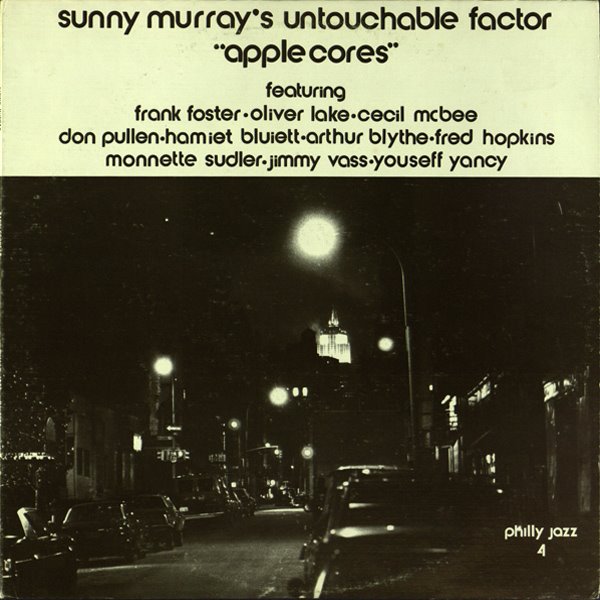
    sunny murray's untouchable factor - "apple cores"

    barabara sounds sez:
    Spiritual, righteous, rare. What more can you say about this album? Just look at all the people involved... This is ripped from the CD reissue of the Baystate album (though the cover art was lifted from the philly jazz imprint which I found here on Discogs). Enjoy... I think you will!

    If this is your bag, then go check out Charred Earth, which Sunny Murray recorded with a very different, smaller version of the 'untouchable factor' aggregation, also for Baystate. It's available over here...

    One of the hippest, tightest sessions ever recorded by drummer Sunny Murray -- a large group set recorded with his Untouchable Factor group -- a great ensemble that includes Frank Foster on soprano sax, Oliver Lake and Arthur Blythe on alto saxes, Hamiet Bluiett on baritone, Don Pullen on piano, and Cecil McBee and Fred Hopkins on bass! The sound is somewhat straighter than Murray's free jazz of a few years before -- almost in the mode that Foster was exploring with some of his large ensembles of the 70s -- a platform for righteous jazz expression, but in a way that's still tied together strongly with a sense of rhythm. Other players on the group include the enigmatic Youseff Yancy on a host of instruments, including theremin -- plus the under-recorded Monette Sudler on guitar. Some tracks are a bit more outside than others -- and titles include "Past Perfect Tense", "One Down & One Up", "Applebluff", "Apple Cores", and "New York Maze".

    Sunny Murray: drums; Frank Foster: soprano sax (1, 2, 3); Oliver Lake: alto sax (2); Jimmy Vass: alto sax (1, 3); Don Pullen: piano (1, 2, 3); Monnette Sudler: guitar (1, 2, 3, 4); Cecil McBee: bass (1, 2, 3); Fred Hopkins: bass (4); Hamiet Bluiett: baritone sax (4); Arthur Blythe: alto sax (4); Abdul Zahir Batin: flute, whistles, percussion (5); Youseff Yancy: trumpet, flugelhorn, theremin, various electro-acoustical sound manipulating devices (1, 3, 4, 5); Sonny Brown: drums (5)

    Mar 17, 2010

    Universal Sounds of America

    barabara sounds sez:
    Sun Ra, Steve Reid, the Tribe sound, Art Ensemble of Chicago... names that need little introduction these days. But for quite a lot of us, this was the album that turned us on to all those wild and beautiful sounds that emerged in the early '70s. Back in the day, this was known as avant guard. I join those who prefer to just call it space jazz.

    amg (thom jurek) sez:
    Universal Sounds of America is one of the early compilations for Great Britain's Soul Jazz label that made a case for a separate imprint that later became Universal Sound. Artists like Pharoah Sanders, drummer Steve Reid and the Master Brotherhood, Byron Morris & Unity Ensemble, David Durrah, New Life Trio, Marcus Belgrave, and last but not least, the Art Ensemble of Chicago and Sun Ra all on the track listing for this set focus, one way or another, on "space being the place." Numerous cuts here employ the word "space" in their titles and one references it directly… While the focus here is on the diversity of, to borrow a term from the AEC, "Great Black Music Ancient to the Future," it is deeply rooted in '70s out jazz, with only Belgrave and Morris providing deeper, wider visions. Morris' nearly twelve-and-a-half minute "Kitty Bey" replies on modal jazz and Latin rhythms to get his killer track across. Likewise, Sanders uses an electric piano to position himself in space on the gorgeous "Astral Traveling," and Belgrave takes nearly ten with his "Space Odyssey," that reflects on funk, electronic abstraction and Detroit soul-jazz to get his rather elegant point across. The rest is all beautifully played and constructed, but the sheer diversity of the sequencing -- though intentionally constructed in this way -- can be a bit much. Still, there isn't anything here not to recommend.