Showing posts with label enja. Show all posts

Jul 1, 2012

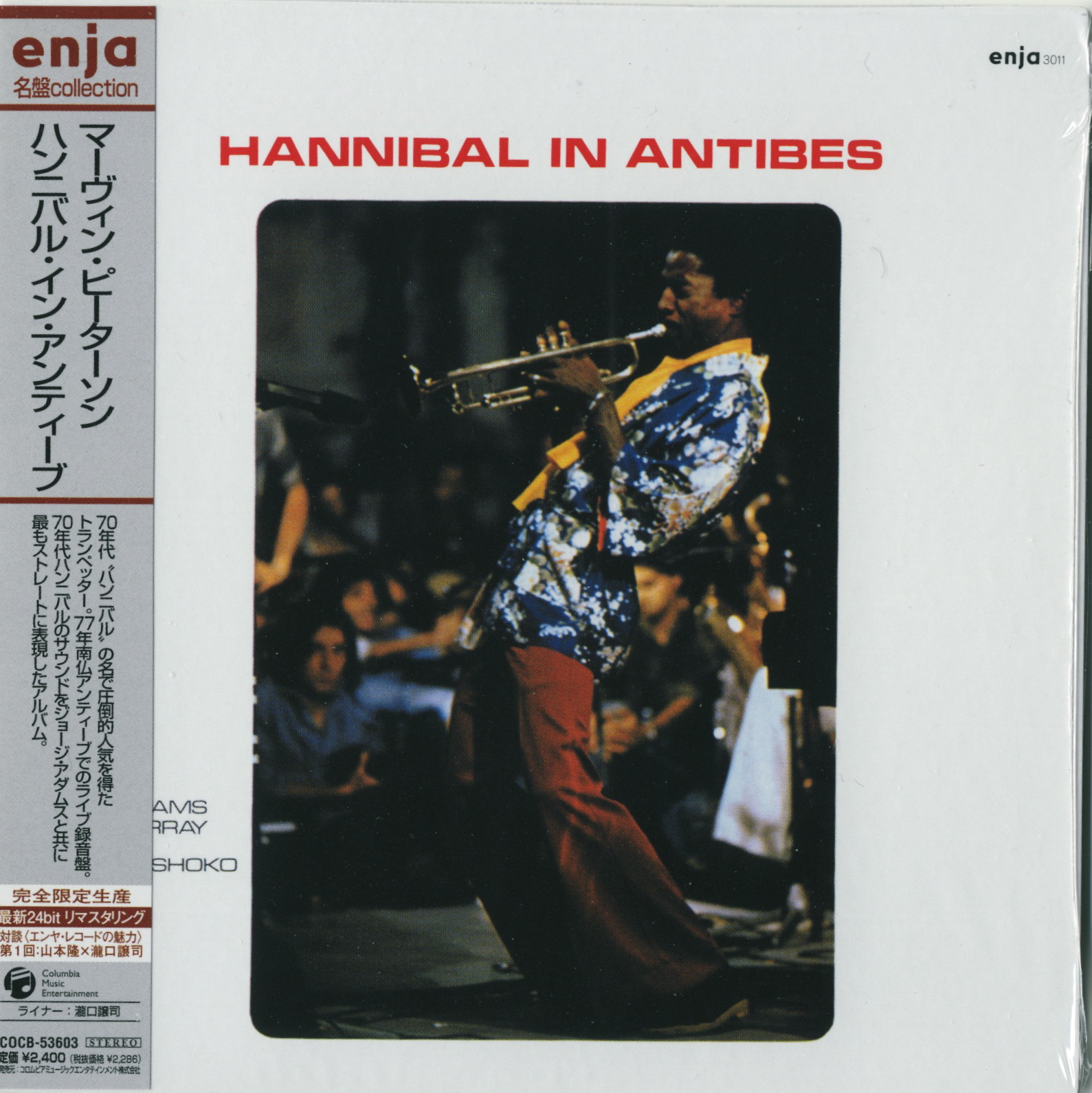
Marvin Peterson - Hannibal in Antibes & the Soulmasters in Concert


barabara sounds sez:
High time I posted some Hannibal. The finest littlest-known trumpet free-funkster ever. So, making up for lost time, here are two sides, both live — except the second (the first chronologicly) is from when Marvin Peterson hadn't yet adopted his alternate name. In Antibes is from 1977, recorded in the south of France and released on enja, and he's at his jazz peak. In Concert with the Soulmasters dates from '68, when he was still just 20 and playing jazz-funk around his home state of TX. Both in their own ways are exceptionally cool...  

dusty sez (on Antibes):
A classic live set from trumpeter Marvin Hannibal Peterson – done with two side-long tracks that really let the group stretch out in a very spiritual way! The performance was captured at the Antibes festival in 1977 – and Hannibal's leading a relatively stripped-down group – with George Adams on flute and tenor, Diedre Murray on cello, Steve Neil on bass, and Mkaya Ntshoko on drums. The mixture of cello and bass, without any piano, echoes some of Peterson's larger ensemble work – but the feel here is much more lively and improvised – a mixture of his freer energies and deeper concepts, which makes for one of his most dynamic records ever.

…and (on live with the Soulmasters):
Rare early work from Hannibal Marvin Peterson – doing it live at the Burning Bush in Denton, TX in November of 1968, around the time Petersonwas still a student at North Texas State University – an incredible formative live document of one of the great soul jazz players, in a more soul & early funk inspired groove than the more exploratory style to come! The set's credited to Marvin Peterson & The Soulmasters – aptly billed, we might add – and it's a mix of organ funk, a more slow cooking number or two, and a couple nods to James Brown style funk soul! Marvin, not yet billed as Hannibal, is on trumpet and he sings on his own "Five Foot Seven" and also contributes some vocals to the JB cover "I Can't Stand It". Tim Peterson is on sax and flute, penned the set opening "Groove For Otis" and co-wrote "Our Groove" with Peterson. The group also covers the Gershwin classic "Summertime" and other players include Mike Campell on alto sax, Clevend Gay on trombone, Eugene Carrier on organ and tamborine, Richard Thompson and Eugene Murray on bass and Emry Thomas on drums.

Dec 20, 2010

Gil Evans Orchestra - Blues in Orbit

barabara sounds sez:
More big band madness as Gil embraces the rhythms of rock and fuses them with free (-ish) jazz charts. There's some really good stuff on here, especially the George Russell-penned title track, but I'm not sure it really adds up to a cohesive whole. That's probably because it's been welded together from two different sessions two years apart. Not (despite what Yawno says) a classic. But still mighty fine...

the guardian (John Fordham) sez:
An intriguing and overlooked curiosity from the great arranger/composer Gil Evans..., the German label Enja having remastered it and restored it to the catalogue. These eight pieces (recorded in 1969 and 1971) track the tentative and always cliche-free flirtations with jazz-fusion that marked Evans's later career - as well as his growing confidence in a looser, collective approach. Half of this programme features Evans's lightly sketched originals, including the brooding Variation On the Misery with its tremulous brass whoops over dark trombone chords, the free-jazz fanfare of Proclamation and the anthemic So Long, a vehicle for the rugged, hollow-toned tenor sax of Billy Harper. …a shade baffled, it's nonetheless a key piece in the Evans jigsaw.

AMG (Scott Yanow) sez:
Gil Evans's first recording as a leader in five years found him leading an orchestra that could be considered a transition between his 1950s groups and his somewhat electric band of the 1970s. Several of these charts, particularly his reworking of George Russell's "Blues in Orbit," are quite memorable, and Evans utilizes his many interesting sidemen, including the distinctive voices of trombonist Jimmy Cleveland, Howard Johnson on tuba and baritone, tenor-saxophonist Billy Harper and guitarist Joe Beck, in unexpected and unpredictable ways. A near-classic release...

Sep 20, 2010

Franco Ambrosetti - Movies + Movies, Too

barabara sounds sez:

Another double header, this time on enja. Swiss trumpeter Franco Ambrosetti's two fine albums, featuring takes on a range of movie theme tunes (or just tunes featured in movies), aided and abetted by some top sidemen. Two separate sessions, from 1987 and 88 (though Ambrosetti's own site says a year earlier than that).

I was dubious at first (after all Yawno recommends them) but there is, as he says, some great jazz on these albums.

And yes these are all my own rips and scans (from the JP remasters) thank you very much.

enja sez:

Born in 1941 in Lugano (Switzerland), Franco Ambrosetti started his recording career in 1964 as a sideman with his father Flavio, then a famous alto sax player. In years to follow he received several trumpet awards, was voted "Best European Jazz Musician" in Italy and was called "the most elegant hard bop trumpeter Europe has ever known." Dedicated to famous film melodies (by Gershwin, Lennon/McCartney, Hancock a.o.) and featuring American star players John Scofield and Geri Allen, "Movies" was Ambrosetti's most successful album in the eighties. Its re-definings of some well-known songs received top ratings, among them the prestigious German Critics Award. British Jazz Journal reads: "Comparisons could be drawn between Ambrosetti and Lester Bowie, in that both have blended gentle satire and serious blowing, but the Italo-Swiss has pulled off the idea with flair and taste."

amg (yanow) sez:

Movies: When one considers the repertoire — eight songs from movies. including the theme from The Magnificent Seven and the Beatles' "Yellow Submarine" — this recording may not seem to have much potential. But actually, the set list includes four well-known standards (including "That Old Black Magic" and "Falling In Love Again"), and all of the music is transformed into creative and consistently exciting jazz. Trumpeter/flugelhornist Franco Ambrosetti is the lead voice, but gives plenty of solo space to his illustrious sidemen... and the performances are generally quite memorable. Recommended.


Movies, Too: This second CD of movie themes once again finds flugelhornist Franco Ambrosetti transforming some unpromising themes into jazz (including "Theme from Superman," "Theme from Peter Gunn" and "What's New, Pussycat"), in addition to better-known standards such as "My Man," "Angel Eyes" and "God Bless the Child"... Well worth checking out.


personnel:

Movies: Franco Ambrosetti trumpet, flugelhorn; John Scofield guitar; Geri Allen keyboards; Michael Foremanek bass; Daniel Humair drums; Jerry Gonzalez percussion


Movies, Too: Franco Ambrosetti trumpet, flugelhorn; John Scofield guitar; Greg Osby alto sax; Geri Allenkeyboards; Michael Foremanek bass; Daniel Humair drums


Arkadin posted a much earlier Ambrosetti album, A Jazz Portrait of... over at his place — here...

May 20, 2010

Archie Shepp — Soul Song

barabara sounds sez:
More Shepp, this is one of my favorite albums of his, all modal sweeps and swoops, propelled by a great, dynamic rhythm section with Marvin "Bugalu" Smith going all out on drums and Kenner Werner on keyboards. I love the extended gospel incantations of Mama Rose and the long modal improv of Geechee. But the highlight (IMHO) is the stately title track, with Werner matching Shepp start to finish — all in 4 short powerful minutes. There's a bonus track on this CD reissue, My Romance, on which Shepp gets all lyrical. This was laid down in Germany in 1982. I do wish I'd seen him in this era, but I only managed to catch him later on.
Yawno disagrees — but there again, his reviews are almost always disagreeable ;-)

Since it's still available from enja here, this one is only up strictly short-term.
Grab it while you can coz it won't be here long. And now it's gone.


AMG (Scott Yawno) sez:
This is one of Archie Shepp's more erratic sets. On the 15-minute "Mama Rose," the great tenor... plays his somewhat out-of-tune soprano and takes an eccentric vocal..The 18-minute "Geechee" is a fine, lengthy workout for Shepp's emotional tenor...

Personnel: Archie Shepp soprano & tenor sax, vocals; Kenny Werner piano; Santi Debriano bass; Marvin "Bugalu" Smith drums

Tracks: 1. Mama Rose; 2. Soul Song; 3. Geechee; 4. My Romance


May 6, 2010

Jane Ira Bloom - Mighty Lights

barabara sounds sez:
More fine music from the neglected and mostly OOP enja catalog. Jane Ira Bloom plays soprano sax, one of the few who do, and she produces some good sounds with it. In more recent years she has used live electronics in her sets, but this 1982 joint is strictly mainstream. She has some top musicians alongside her here — Fred Hersch on piano; Charlie Haden on bass; and Ed Blackwell on drums — and this swings nicely.

Two things worthy of note about Jane Ira Bloom: she was the first musician to be commissioned by the NASA Art Program — though I haven't heard any of her three musical compositions. She also has an asteroid named after her.


AMG (Chris Kelsey) sez:
This was, in a way, Jane Ira Bloom's debut, in that it was the first of her albums to be put out by a label she did not herself own -- her first two records were self-produced. Even at such an early stage in her development one can hear the attention to craft that would always characterize her work, though her skills at this point were not what they would later become. Bloom's control over the horn was occasionally dubious, but she evidenced an attractive tone and a coherent (if a bit immature and self-conscious) manner of phrasing. Her tunes were already quite sophisticated and distinctive, pointing to the even more ambitious composer into which she evolved. On the other hand, her band for this album will probably not be excelled for the rest of her career. Charlie Haden and Ed Blackwell are pretty heavy company for such a callow young musician to be keeping, and pianist Fred Hersch is certainly no slouch. Obviously, the rhythm section's work raises this music to a higher plane than it would have reached had not Bloom the wherewithal to engage the services of these gentlemen.

Feb 26, 2010

David Friedman - Of The Wind's Eye

barabara sounds sez:
Another little-known gem from the enja catalog. David Friedman lays down some wonderful marimba and vibes, complemented beautifully by the understated sax work of Jane Ira Bloom and backed up by Harvie Swartz on bass and Daniel Humair on drums. This is finely crafted lyrical music (can you tell I like it?!)
David Friedman is still making plenty of music; here's his home page...

amg (Ron Wynn) sez:
Friedman played with The New York Philharmonic and Metropolitan Operas in the '60s, then worked with Wayne Shorter, Horace Silver, Joe Chambers, Hubert Laws and Horacee Arnold in the '70s. After touring and participating in Ludwig Drum Co. workshops with Dave Samuels, Friedman and Samuels formed The Mallet Duo in 1975 and co-led the quartet Double Image from 1977 to 1980. Friedman recorded with Daniel Humair in 1979 and Chet Baker in 1982. He was an instructor at New York's Manhattan School of Music and Montreux's Institute for Advanced Musical Studies in the mid-'70s.

Jan 27, 2010

Kenny Barron - What If

barabara sounds sez:
Kenny Barron on enja, maybe not as outstanding as his earlier work on Muse, but still well worth the aural excursion. Not a bad line-up either: alongside Kenny Barron on piano there's John Stubblefield on tenor sax [NB what's cduniverse on about, he's not from UK shurely?], Wallace Roney on trumpet, Cecil McBee on bass, and Victor Lewis drums. 'Nuff said.

Pianist Kenny Barron leads a quintessential post-bop quintet on 1986's WHAT IF? with help from the contemporary jazz star trumpeter Wallace Roney, and the British tenor saxophonist John Stubblefield. Except for Thelonious Monk's "Trinkle, Tinkle," these compositions are all Barron originals, and what is most striking is how much these tracks — "Phantoms" and "Voyage" especially — sound like a typical Herbie Hancock or Hank Mobley Blue Note session of the late-'50s and early-'60s, just as the post-bop idiom was being defined. The prodigious pianist displays his Bud Powell-like virtuosity on the aptly titled "Dexterity," slowing down the tempo just enough for the intricate ballad "Close To You Alone." Veteran bassist Cecil McBee and the versatile drummer Victor Lewis provide supple support throughout the set.

Although Kenny Barron's always a heck of a great musician on his own or in a piano trio, we're especially partial to his work in groups with horn players -- and this album is a great example of that preference! Kenny first came to fame working with Dizzy Gillespie in the 60s, and since that point, he's always had a tremendous ear for the right tones and shadings from horns needed to augment his own soulful vision on the keys -- a way of setting up the other players in the group to build on the well-crafted Barron lines, and take them even further into the stratosphere. This set follows that format, and draws great energy from Wallace Roney on trumpet and John Stubblefield on tenor -- both at their younger best, and working alongside Kenny's piano with Cecil McBee on bass and Victor Lewis on drums. The lineup sparkles most on the 4 longer Barron numbers on the album -- "Phantoms", "What If", "Voyage", and "Lullabye" -- all of which take us back to the brilliance of Kenny's best Muse albums of the 70s. Other tracks feature smaller, more piano-centrist groupings -- on tracks that include "Dexterity", "Close To You Alone", and "Trinkle Trinkle".