Showing posts with label bass. Show all posts

May 18, 2013

Teruo Nakamura - Unicorn


barabara sounds sez:
Another classic TBM side from 1973, and probably the best thing that Nakamura ever laid down. Which is all thanks to the company he keeps here. It is (as TJ points out) a bit of a mixed bag, and I'm with those who say Umma Be Me, soulful and funky though it is, doesn't really belong on the album. But the other tracks more than make up for it, especially the final two tracks. Dusty, on the other hand, seems to like it all start to finish!

dusty sez:
A landmark album from the Japanese fusion scene of the 70s – a killer set of tracks recorded by bassist Teruo Nakamura, with help from a host of American soul jazz luminaries! The album's easily one of Nakamura's most sought-after sets – cut in New York in 1973, with players that include Steve Grossman, George Cables, Lenny White, Hubert Eaves, and Alphonze Mouzon. Tracks are long and jamming, but also have a wonderfully soulful component – a bit of the post-Coltrane spiritualism of some of Gary Bartz's early albums, and some of the open-ended styles you might hear on a label like Strata East. Singer Sandy Hewitt sings on 2 tracks – including the funky "Umma Be Me", which almost feels like an Andy Bey groover from the same time!

allmusic.com (thom jurek) sez:
Unicorn was bassist Teruo Nakamura's first date as a leader. Recorded and issued in Japan on the legendary Three Blind Mice imprint in 1973, Nakamura had been working in New York since 1964. He'd done a lot of hardscrabble work before 1969 when he landed the gig as bassist in Roy Haynes' fine group of the time. During that year he formed a band with Steve Grossman and Lenny White, who both appear here. This is an interesting date because it is equally divided between very electric fusion tracks and more modal acoustic numbers…
The music is very much of its time, and though it is a session players gig, with rotating lineups, there is plenty of fire here. Grossman had already done his stint with Miles Davis and is in fine form on soprano (especially on the opening title cut), and tenor on John Coltrane's "Some Other Blues." White and Mouzon are both outstanding, so the drum chair is killer throughout, no matter who's playing, and Cables' Rhodes work on the Trane cut and "Derrick's Dance," written by Miller, is stellar. Nakamura, for his part, is more than an able bassist; he leads by guiding the rhythm and not standing out as a soloist. This set has aged very well and was finally issued in the states on CD in 2007 on the Passion Music imprint.

tracks:
Unicorn Lady; Understanding; Some Other Blues; Umma Be Me; New Moon; Derrick's Dance

musicians:
Teruo Nakamura bass; Steve Grossman soprano sax; Charles Sullivan trumpet; George Cables electric piano, piano; Hubert Eaves III electric piano, piano; John Miller piano; Alphonse Mouzon drums; Lenny White drums; Ronald Jackson percussion; Alvern Bunn congas; Keiji Kishida percussion; Sandy Hewitt vocals


Dec 1, 2012

Hideto Kanai Quintet - Concierto de Aranjuez


somebody (can't find the link now) sez:
A progressive, daring jazz date. The title track is an impressive answer to the earlier versions by Miles Davis and Jim Hall.

barabara sounds sez:
Damn right it is. Listen to Miles… and then to Hall... and then wrap your ears around Kanai and his quintet. They're not kind-of sort-of  "thereabouts": they're absolutely "there". The rest of the album is none too shabby either!

Tracks:
01 Concierto de Aranjuez
02 Tensions

03 For Charles
04 What Love
05 Congratulation
06 Rhapsody in Blue

Personnel:
Hideto Kanai bass
Toshihiko Inoue soprano sax; tenor sax
Mikinori Fujiwara alto, soprano & tenor sax, flute
Yoshito Osawa piano
Michael Reznikoff drums. 


Jul 12, 2011

Isao Suzuki Trio - Black Orpheus

barabara sounds sez:
Sukuki is one of the j-jazz greats — and this is one of his top sessions, laid down for the TBM label in 1976. The album title is a bit of a red herring, since the only music from Black Orpheus is the first track, the classic
Manha De Carnaval. That's also the standout track — but the whole of the album grooves very nicely too, thanks to Yamamoto's nifty keyboard work, especially on the Rhodes, with Donald Bailey anchoring everything most effectively.

someone else (can't remember where I found this) sez:
Isao Suzuki is one of the most important recording artists on the TBM label. Until his last album “Touch!”, he usually recorded with Kazumi Watanabe on guitar and his old friend Kunihiko Sugano on piano. However, he thinks highly of Tsuyoshi Yamamoto on piano and at a joint concert with Kenny Burrell, Suzuki asked Yamamoto to join him. Yamamoto’s powerful technique and taste for swing are a good match for Suzuki.

While Donald Bailey is a really exciting drummer. Donald grew up in Philadelphia and has amassed a lot of experience, including playing with top organist Jimmy Smith for nearly eight years. Unique in his drums setting is that his snare is fixed extremely oblique and tom-toms were fixed close to the snare. In addition, various bells and chimes are usually hung up. His favorite style is jazz mixed with latin beat. His simple but exciting jazz beat is very attractive and influential in the group.

musicians:
Suzuki
Isao
bass & cello; Yamamoto
Tsuyoshi
piano & electric piano; Donald Bailey drums

tracks:
Manha De Carnaval; Angel Eyes; Who Can I Turn To; In a Sentimantal Mood; Blues

tbm-63 recorded in Tokyo, Feb.20 1976

Jan 3, 2011

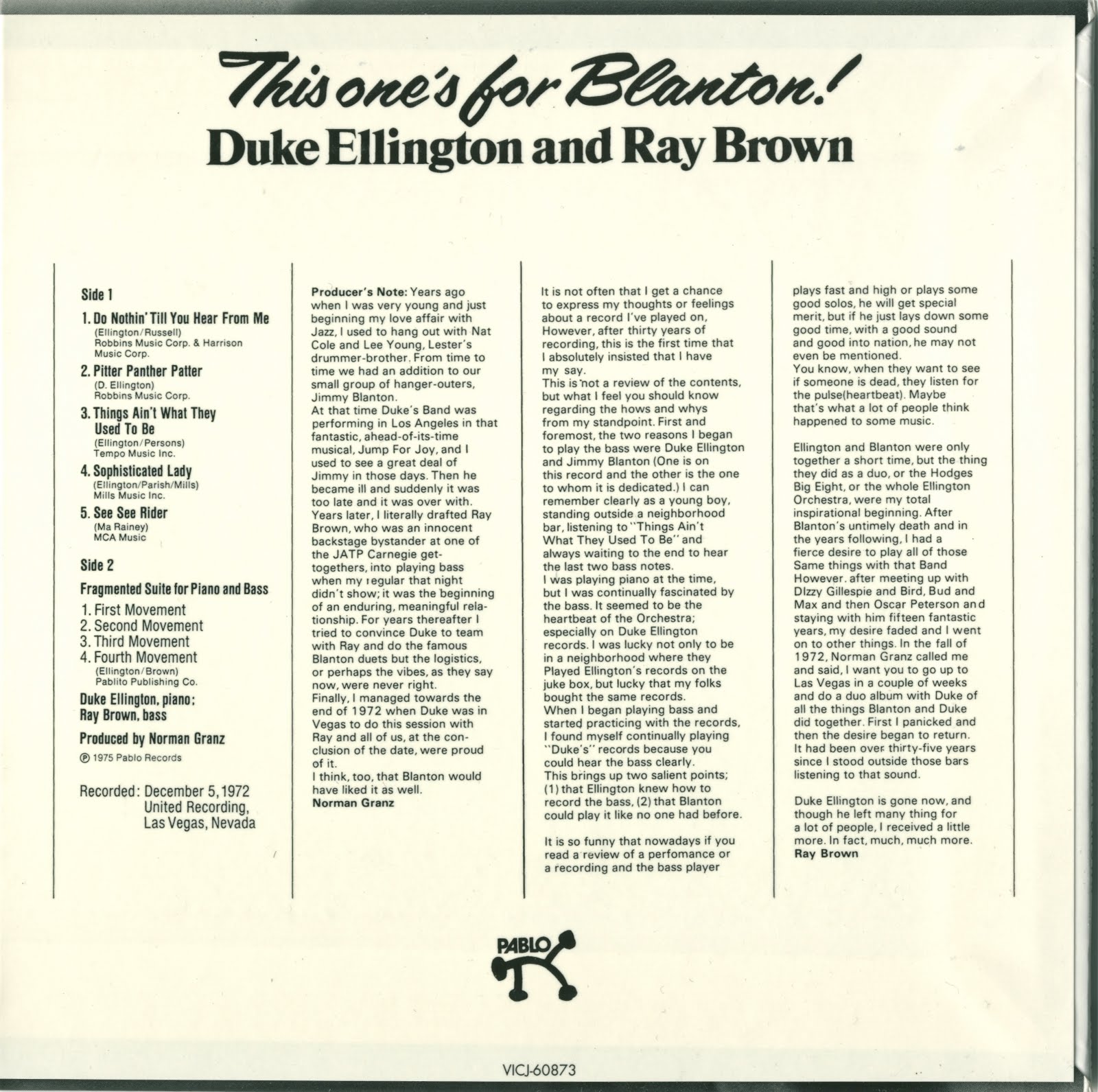
Duke Ellington and Ray Brown - This one's for Blanton!

barabara sounds sez:
It doesn't get much simpler than this: just piano and bass. But there is so much music here, with Ellington and Brown just hitting the perfect groove. I love the de/reconstructed See See Rider. But it's the second side that really does it for me, the four-part Fragmented Suite for Piano and bass. This was just about the last session Duke ever recorded. And I've got to say, it's one of the most beautiful I've ever heard of his. Not that I've heard them all — in fact one of my new year resolutions is to listen to a lot more of the older albums Ellington did in the 50s and beyond. This is from the JP reissue of the Pablo album, and it's a bona fide barabara classic.

From the sleeve notes by Ray Brown:
Ellington and Blanton were only together a short time, but the thing they did as a duo, or as the Hodges Big Eight, or the whole Ellington Orchestra, were my total inspirational beginning. After Blanton's untimely death and in the years following, I had a fierce desire to play all of those same things with that band. However... I went on to other things. In the fall of 1972, Norman Granz called me and said, I want you to go up to Las Vegas in a couple of weeks and do a duo album with Duke of all the things that Blanton and Duke did together. First I panicked and then the desire began to return. It had been over thirty-five years since I stood outside those bars listening to that sound. Duke Ellington is gone now, and though he left many things for a lot of people, I received a little more. In fact, much much more.

When he died in 1942, Duke Ellington’s 21-year-old bassist, Jimmy Blanton, had liberated the string bass from its traditional role as an accompanist. Two of Blanton’s disciples, Ray Brown and Oscar Pettiford, carried forward his work of developing the bass into a solo instrument. Their contributions had a great deal to do with bebop’s becoming a mature music. More than 30 years after Blanton’s death, Brown went into a studio with Ellington to pay homage to his idol. Their duets echo the famous ones of Ellington and Blanton and demonstrate Brown’s creativity and virtuosity on the Blanton model.

If you like this, then check out Reza's post of the Ellington suites, also on Pablo... highly recommended!

Nov 26, 2010

Reverie - Reverie

barabara sounds sez:
I don't know much about this band or this album, other than what's here in front of me: a limited edition reissue of the band's first album which originally came out in 1980.
It appears they were together for a dozen years or so, made 3 or 4 albums and gigged solidly without making too much impact (except in Philly, where apparently they were 'legendary')...

On some of these tracks you can tell they spent plenty of time listening to Weather Report. And interestingly, bassist Gerald Veasley went on to play with the Zawinul Syndicate for some seven years (also with Grover Washington and plenty others). None of the other band members seem to have made it big, but they certainly had pretty fine chops. Whether or not you like the music will depend on what your take is on fusion/electro jazz.

personnel:
Mark Knox keyboards; Ed Yellen sax; Gerald Veasley bass; Jim Miller drums; also Stan Slatter trumpet, flugelhorn, flute; Larry Coryell guitar (track 4)

There's some footage of Reverie in action here and here and here.
Also a nice number featuring Veasley with the Joe Zawinul Syndicate here...
And I just noticed that he's also featured on a couple of Odean Pope albums here and here, posted recently by PostMiles.