Jan 25, 2011

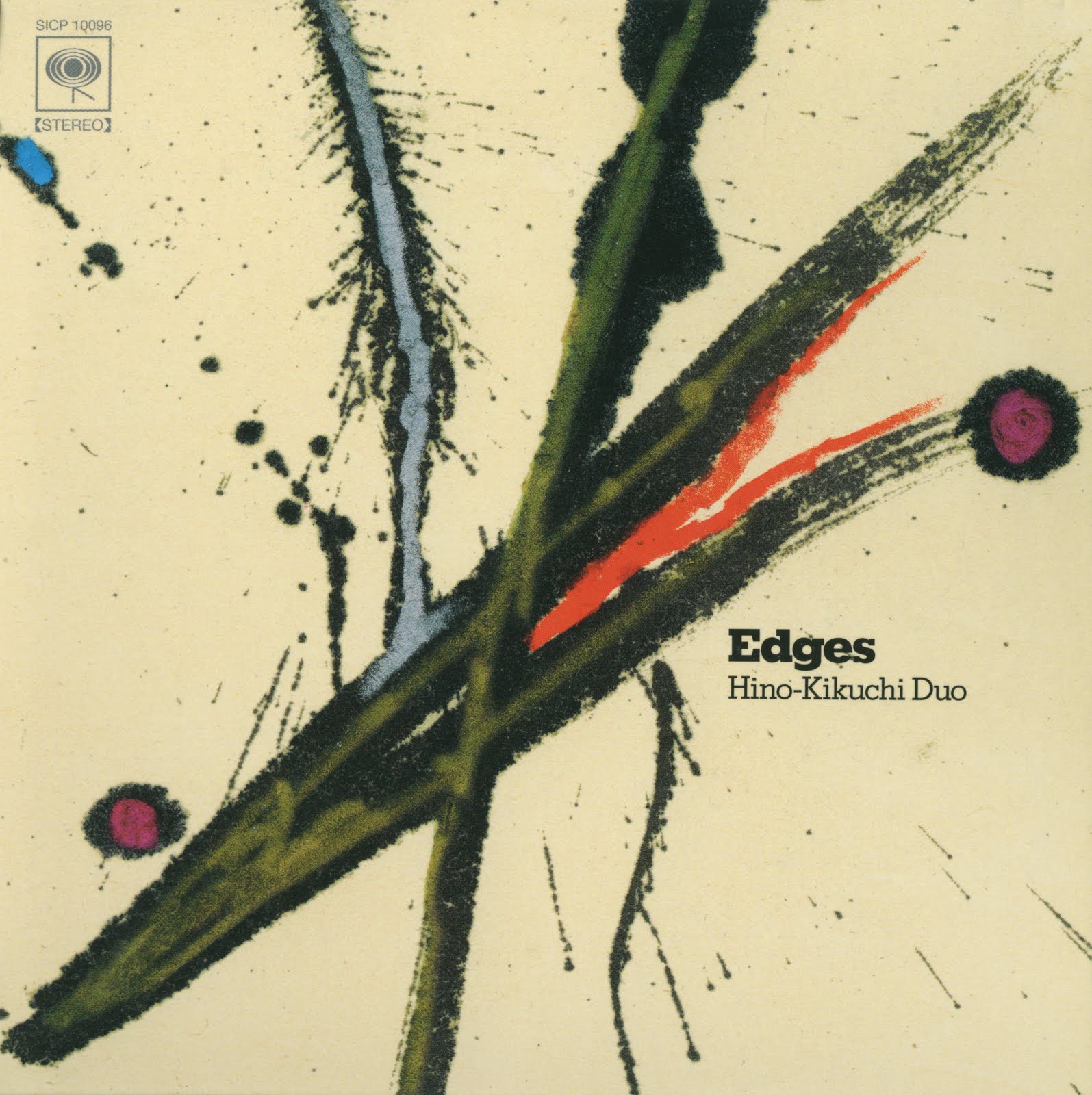
Hino-Kikuchi Duo - Edges

barabara sounds sez:
It's about time I posted this, the companion piece to my earlier post (back in November) of Counter Current. I'm not sure why I've held it back till now. Maybe because it's sparer, less 'straightforward' — I'm tempted to say edgy, but that would give the wrong impression — it demands more attention and grabs you in a rather different place. But it's not because I like it any less.

Even though it was recorded during the same sessions as Counter Current, this is a very different album. As you can tell, it's just the two of them, Terumasa Hino and Masabumi Kikuchi, just trumpet and piano, sometimes together other times exploring out there on their own. Curiously, the cover art is in bold color, whereas the sleeve for Counter Current is sumi ink on washi white — but Edges is by far the more monochromatic in its soundscapes. Here's a nice review from All About Jazz, says it better than I can...

AAJ (Andrey Henkin) sez:
The similarities between two new releases by Japanese legends Terumasa Hino and Masabumi Kikuchi are obvious. Both were recorded within the same two weeks at the same studio. Both share broadly painted abstract covers on their appealing LP-style gatefold sleeves. Both are mostly originals by the pair, including two versions of two pieces book ending each disc. Even the aesthetics, despite the first being a duet and the other a quintet, have something in common. Palpably companion pieces, for all their similarities, these are distinct albums. But one thing they both contain is possibly the most surprising. Though continuing a partnership begun decades ago, the albums don't demonstrate an expected easy comfort; that is their strength.

Edges is an uncommon duet between an unusual pairing. Piano and trumpet inhabit a similar tonal range so any counterpoint is of a subtler breed. The eight pieces, including the two takes of the title track that begin and end the album, are aural representations of the album artwork: painted in bold expressionistic strokes. What is fascinating though is the tangible sense of tension. When one listens to a duet, breezy dialogue or spirited agreements are usually the expectation. Hino and Kikuchi are obviously old friends but ones who seem to have little in common. When their careers began, they were closer in spirit; the intervening years have separated them. They are like adults who are friends because they grew up next to each other. This turns Edges into a session whose appeal is in its agitation. Each author has his pieces dominated by the other musician and the solo pieces are almost exhalations. "I Fall In Love Too Easily," the album's only standard, exemplifies this ironic relationship.

personnel:
Terumasa Hino: trumpet; Masabumi Kikuchi: piano.

tracks:
Edges (ver. 1); Is It?; Alone, Alone And Alone; Can't Describe; I Fall In Love Too Easily; Dad, I Miss You (trumpet solo); My Kinda Yesterday (piano solo);
Edges (ver. 2)


Jan 13, 2011

Hidefumi Toki & The Super Jazz Trio - City-Toki

barabara sounds sez:
Hidefumi Toki burst onto the scene back in the early 70s as the sax player in Toshiyuki Miyama's New Herd — in fact I was reminded of this album by Katonah's great recent post of Sunday Thing over on his always essential Private Press [even though Toki didn't actually play on that one]. Before long Toki was leading his own unit, and by the time City-Toki came out in 1978 he was just about at the top of his game. Most of what came next is not really worth exhuming — a sad decline into fuzak and session wilderness. But on this album, cut in NYC, he certainly shows he has the chops to hold his own with a rhythm section of the quality of Flanagan, Workman and Chambers. He's also come up with some nice compositions. I can't say it's absolutely all killer [to quote a line] but it's definitely more than just filler.

Recorded July 6 1978 at Sound Ideas Studio NYC; issued on Baystate; this is ripped from the 2005 JP-only CD reissue.

personnel:
Hidefumi Toki alto sax, soprano sax; Tommy Flanagan piano; Reggie Workman bass; Joe Chambers drums

There's a [not totally complete] Toki discography here...

Jan 3, 2011

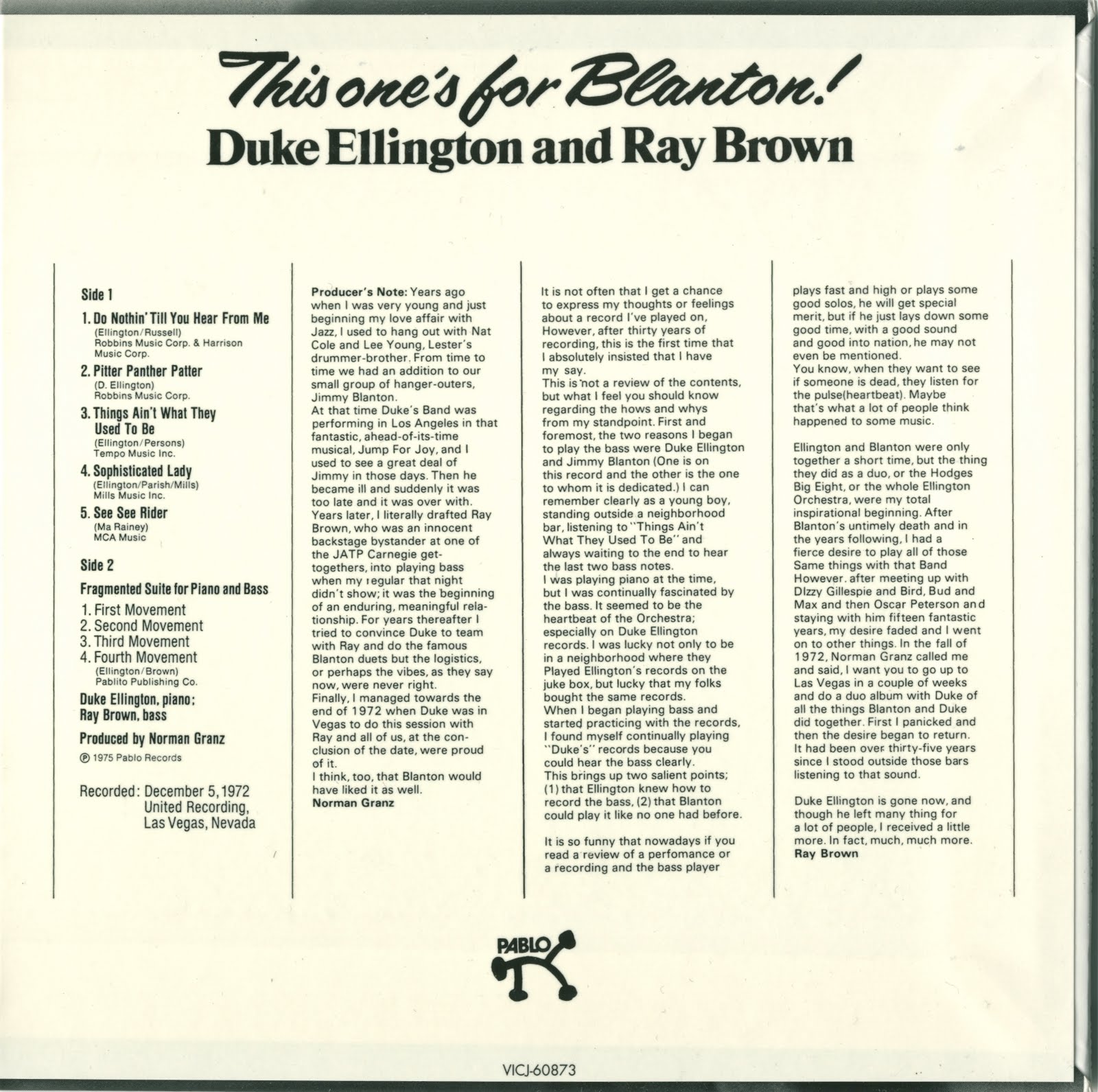
Duke Ellington and Ray Brown - This one's for Blanton!

barabara sounds sez:
It doesn't get much simpler than this: just piano and bass. But there is so much music here, with Ellington and Brown just hitting the perfect groove. I love the de/reconstructed See See Rider. But it's the second side that really does it for me, the four-part Fragmented Suite for Piano and bass. This was just about the last session Duke ever recorded. And I've got to say, it's one of the most beautiful I've ever heard of his. Not that I've heard them all — in fact one of my new year resolutions is to listen to a lot more of the older albums Ellington did in the 50s and beyond. This is from the JP reissue of the Pablo album, and it's a bona fide barabara classic.

From the sleeve notes by Ray Brown:
Ellington and Blanton were only together a short time, but the thing they did as a duo, or as the Hodges Big Eight, or the whole Ellington Orchestra, were my total inspirational beginning. After Blanton's untimely death and in the years following, I had a fierce desire to play all of those same things with that band. However... I went on to other things. In the fall of 1972, Norman Granz called me and said, I want you to go up to Las Vegas in a couple of weeks and do a duo album with Duke of all the things that Blanton and Duke did together. First I panicked and then the desire began to return. It had been over thirty-five years since I stood outside those bars listening to that sound. Duke Ellington is gone now, and though he left many things for a lot of people, I received a little more. In fact, much much more.

When he died in 1942, Duke Ellington’s 21-year-old bassist, Jimmy Blanton, had liberated the string bass from its traditional role as an accompanist. Two of Blanton’s disciples, Ray Brown and Oscar Pettiford, carried forward his work of developing the bass into a solo instrument. Their contributions had a great deal to do with bebop’s becoming a mature music. More than 30 years after Blanton’s death, Brown went into a studio with Ellington to pay homage to his idol. Their duets echo the famous ones of Ellington and Blanton and demonstrate Brown’s creativity and virtuosity on the Blanton model.

If you like this, then check out Reza's post of the Ellington suites, also on Pablo... highly recommended!

Dec 28, 2010

Nathan Davis - London By Night

barabara sounds sez:
In my book Nathan Davis can do no wrong. That said, if I had to choose a decade, I would always go for his '60s sides (such as Peace Treaty and Funny Girl) above his later works. But by anyone else's standards, London By Night — from 1987 and, yes, recorded in the UK capital over a couple of nights — is a fine album and Davis is in great fettle on his horns (soprano as well as tenor) and also flute. The title track swings nicely, though the standout track for me is the beautiful Rio de Janeiro. If there's one glitch, it's the anachronistic Beatles cover. But that comes right at the end so you can just program it out. This one's from the Disk Union CD reissue...

dusty sez:
Overlooked genius from reedman Nathan Davis – a later session that's a bit more straight ahead than some of his 70s work, and a date that really gets back to some of the best soulful energy of his records from the 60s! Davis is recorded here in very sympathetic company – players who share some of the best energies he picked up on the expatriate scene during his famous time overseas – Dusky Goykovich on trumpet, Kenny Drew on piano, Jimmy Woode on bass, and Al Leavitt on drums! There's an easygoing soul jazz groove to the whole set, with a slight touch of modernism – and in addition to tenor, Davis also plays some wonderful soprano sax – handling the horn with stretched-out soulfulness that makes him one of the undisputed masters of the instrument.

A couple more enthusiastic quotes:
Rough Guide sez: "Shows Nathan Davis at the top of his post-bop form"
Penguin Guide sez: "Could almost be from an undiscovered Jazz Messengers tape. Goykovich's flugelhorn has a fat, luxuriant quality that that blends well with Davis... there are fine, controlled solos all round, notably on 'Dr Bu', where the Blakey/Messengers debt is most openly acknowledged..."

personnel
Nathan Davis (tenor sax, soprano sax, flute); Dusko Gojkovic (trumpet, flugelhorn); Kenny Drew (piano); Jimmy Woode (bass); Al Levitt (drums); Stan Robinson, Jean Toussaint (tenor sax on Shades)

tracks:
Noite Em Leblon; I Thought About You; Rio De Janeiro; London By Night; Dr Bu; But Beautiful; You've Changed; Shades; Lament; If I Fell

recorded
Boathouse Studios, London (04/17/1987-04/18/1987)

Dec 25, 2010

Listen, The Snow Is Falling

barabara sounds sez:
Merry holidays to all my blogosphere friends — and everyone else.

And for everyone in Europe (and elsewhere) stuck in the snow: stop... look... and listen! Stay warm and well!

Dec 20, 2010

Gil Evans Orchestra - Blues in Orbit

barabara sounds sez:
More big band madness as Gil embraces the rhythms of rock and fuses them with free (-ish) jazz charts. There's some really good stuff on here, especially the George Russell-penned title track, but I'm not sure it really adds up to a cohesive whole. That's probably because it's been welded together from two different sessions two years apart. Not (despite what Yawno says) a classic. But still mighty fine...

the guardian (John Fordham) sez:
An intriguing and overlooked curiosity from the great arranger/composer Gil Evans..., the German label Enja having remastered it and restored it to the catalogue. These eight pieces (recorded in 1969 and 1971) track the tentative and always cliche-free flirtations with jazz-fusion that marked Evans's later career - as well as his growing confidence in a looser, collective approach. Half of this programme features Evans's lightly sketched originals, including the brooding Variation On the Misery with its tremulous brass whoops over dark trombone chords, the free-jazz fanfare of Proclamation and the anthemic So Long, a vehicle for the rugged, hollow-toned tenor sax of Billy Harper. …a shade baffled, it's nonetheless a key piece in the Evans jigsaw.

AMG (Scott Yanow) sez:
Gil Evans's first recording as a leader in five years found him leading an orchestra that could be considered a transition between his 1950s groups and his somewhat electric band of the 1970s. Several of these charts, particularly his reworking of George Russell's "Blues in Orbit," are quite memorable, and Evans utilizes his many interesting sidemen, including the distinctive voices of trombonist Jimmy Cleveland, Howard Johnson on tuba and baritone, tenor-saxophonist Billy Harper and guitarist Joe Beck, in unexpected and unpredictable ways. A near-classic release...

Dec 5, 2010

Ravi Coltrane - Mad 6

AAJ (Mark F.Turner) sez:

Recorded in New York in 2002... the ten selections were recorded with two different groups, including the talents of pianist George Colligan and bassist James Genus on one half of the tracks with pianist Andy Milne and bassist Darryl Hall on the other half. Both groups share the skills of drummer Steve Hass.


Ravi bookends the set with two of his father’s compositions “26-2” and “Fifth House”; each delivered with contemporary facelifts. His tenor tone is deep and muscular as he delivers angular and quick notes. On the aforementioned cuts the tempos are fast with Ravi and Colligan trading burning solos. Ravi is also equipped with a potent soprano arsenal on Jimmy Heath’s “Ginger Bread Boy” and Thelonious Monk’s timeless “Round Midnight,” which is reborn with a very funky groove.


Ravi’s own selections are also significant as he adds odd cadences on “Avignon“ and “The Return of the Olymbus.” Steve Hass delivers polyrhythms galore and Genus and Hall also provide staunch bass lines and solos. Slower selections continue to reveal a lush tenor sound on Mingus’s “Self Portrait in Three Colors”. The selection ends with Ravi silhouetting the melody behind a nice bass solo by James Genus.


BBC (Peter Marsh) sez:

This is a pretty fierce blowing session; the opening "26-2" (one of the album's two John Coltrane tunes) bursts out of the traps like a greyhound on steroids. The leaders's tenor wraps itself with an easy grace around the kind of fierce, metrically tricky pulse that Dave Holland excels at. This kind of rhythmic cut and thrust informs most of Ravi's original tunes; there are echoes too of Steve Colman's cerebral fun moves (particularly on "Between Lines"). But there's a warmth here often absent in Coleman's work.


Like his dad, Ravi has a gift for choosing drummers. Steve Hass propels two different quartet lineups with intelligence and a formidable technique which suggests he's been listening to the cutups of drum 'n' bass as much as Tony Williams or Roy Haynes. Like Billy Kilson or Marvin Smith, he's always up to something worth listening to, while on the slower tunes he's beautifully unobtrusive. Mingus's "Self Portrait in Three Colours" is especially lovely, with George Colligan's plangent piano underpinning an emotive, considered solo from the leader. Similarly Monk's "Ask Me Now" (opening with sweet solo statement from bassist James Genus) gets a sympathetic treatment...


barabara sounds sez:

This is probably my favorite of Ravi Coltrane's albums as leader. But you have to hear the man playing live — especially if it was alongside his mother. Not that I did — but there are two brilliant live sets posted over at Ish's wonderful Ile Oxumare, here and here.


He's currently on a short US tour — details here. And you can hear a few tracks over at his web site here...