Sep 26, 2011

Art Ensemble Of Chicago & Lester Bowie's Brass Fantasy - Live At The 6th Tokyo Music Joy '90


barabara sounds sez:
Back in February of 1990, the Art Ensemble of Chicago came to town to play at the annual Tokyo Music Joy festival – and they shared the stage with Lester Bowie's side project, his Brass Fantasy. This isn't the entire concert so some continuity does get lost, but it certainly gives a great sense of what a fun occasion it was. This is from the Disk Union CD, which gives us three tracks each of the two bands playing separately, and another four tracks of them together creating a rollocking brass-fueled celebration. Great stuff!

the chicago tribune (in 1991) sez:
What a splendid group Lester Bowie's Brass Factory has become. Three recent releases (from the magnificent DIW archives just now becoming available in this country) stake a claim for this ensemble as among the most exciting groups playing today. Bowie’s genius is in marrying edgy post-modern schtick with pure, old-time fun so that the pleasure of listening to themes from the "Phantom of the Opera" or the early rock and roll standard “Great Pretender” (let alone “My Way”) is not wholly in the listener’s head. This music goes right down the spine, which is where feeling begins. For a celebration of what new music can be when it retains its sense of delight, listen to these three discs – especially the one with the Art Ensemble of Chicago, which has never been more wonderful.

an amazon reviewer sez:
The material is wonderful, playful, and varied, with the highest point probably being a truly New-Orleansy workout by the combined bands on "A Jackson in your House," a really goofy song from one of AEC's early BYGs. There are also some free-ish moments, but Brass Fantasy were more about PoMo pastiche and twisted traditionalism than improvisation, so they tend to transform things a bit, bringing Jarman and Mitchell and Favors and Moye "in" from the "outside"... Fans know that one of the most magical things about Lester Bowie's Brass Fantasy was their ability to transform a pop song you'd never be caught dead listening to into something really magical and acceptable as music. On this disk, the unexpected bit of cultural salvage is Andrew Lloyd Webber's "Music of the Night."
It's really wonderful, even if you hate Webber.


Sep 12, 2011

Masaru Imada Quartet - Now!!

barabara sounds sez:
Now! more from the TBM catalog, but this time not from my archives. Instead, it's another outstanding share from bongohito — who also contributed that awesome threesome over at Bacoso's place just recently. This was (I do believe) Imada's first album as a leader – though he recorded Maki in the same year with the same band – and it's a real corker.

Side 1 gets us under way in languid late-night mood, with Nostalgia, a stately ballad that gives Mimori a chance to open up on tenor. Next up is Alter, which opens with the spotlight on Ozu and Mizuhashi before developing into free exploration with plenty more good work by Mimori. But it's Side 2 that really delivers, two fantastic tracks, the mighty modal Gehi Dorian, which really cuts loose with a righteous groove. To close Imada and his crew dial it back a bit, and go out in lyrical style with The Shadow.

somebody else (can't find an attribution) sez:
Now! by Masaru Imada was the second album released by the fledgling Three Blind Mice label and the pianist's first leader album for the label. All four tunes are Imada's original compositions. The two slow numbers – "Nostalgia" and "The Shadow of the Castle" show his lyrical, "quiet but emotional" qualities. "Alter" is an adventurous tune whose focus is on free improvisation while "Gehi Dorian" is a modal composition as the title suggests.

musicians: 
Masaru Imada piano; Ichiro Mimori tenor & soprano sax; Takashi Mizuhashi bass; Masahiko Ozu drums

tracks:
1. Nostalgia; 2. Alter; 3 Gehi Dorian; 4. The Shadow of the Castle

TBM-2; recorded August 10/11, 1970 at Aoi Studio, Tokyo; reissued on SACD 2000

Aug 30, 2011

Yoshio Otomo Quartet - Moon Ray


barabara sounds sez:  
Back again to the j-jazz archives. This side from Yoshio Otomo is pretty rare, and TJ (below) rates it highly. And yes, maybe it is his "most important work". But I've got to say, it's really not one of my favorites from the TBM catalog. To me it sounds about a decade out of date: Whereas his label mates are pushing the fusion/free envelope, Otomo-san has his feet planted firmly back in the 60s. But that might be a recommendation for some people. Let your own ears be the judge... 

AMG (Thom Jurek) sez:
Otomo is an alto player from the Jackie McLean school of tone and the Art Pepper institute for improvisation. In other words, his tone has an edge, but he always phrases and improvises melodically. With Tsuyoshi Yamamoto leading the rhythm section, the other two members, Tamiko Kawabata on bass and Arihide Kurata on drums, had to be ever watchful and vigilant that these proceedings didn't escape them altogether. The set opens with the hard blues wing of the title cut by Artie Shaw. Otomo pushes his alto in the front line toward the lower register, establishing the feeling from the outset before going back up top for his solo. Yamamoto comps forcefully, rhythmically changing the modal interval from inside. It works, and swings as it echoes the blues of jazz yesteryear, though the emotion and sophistication of the players is unquestionable. The other tunes here, Johnny Mandel and Johnny Mercer's "Emily," Oliver Nelson's "Shufflin'," and Ralph Rainger and Leo Robin's "If I Should Lose You" are all played with grace and sensitivity. There isn't any over-teching anything -- a real temptation by Japanese jazzers in the '70s to sound authentic. This is as authentic as anything because the feeling is in the music. That comes through loud and clear on the only original of the set, "Love Comes Quietly," where Archie Shepp's dictum that you can hear every minute of every hour of every day a cat puts into his horn on a ballad: All men are fine soloists, and the melody itself is gorgeous, worthy of the rest of the company it keeps here. A great obscure reissue, and a fine introduction to Japanese jazz.

musicians:
Yoshio Otomo alto sax; Tsuyoshi Tamamoto piano; Tamio Kawabata bass; O "Jess" Kurata drums

tracks:
Moon ray; Emily; If I should lose you; Love comes quietly; Shufflin'

TBM 3007. rec. April 21/22, 1977 at Epicurus, Tokyo

Aug 16, 2011

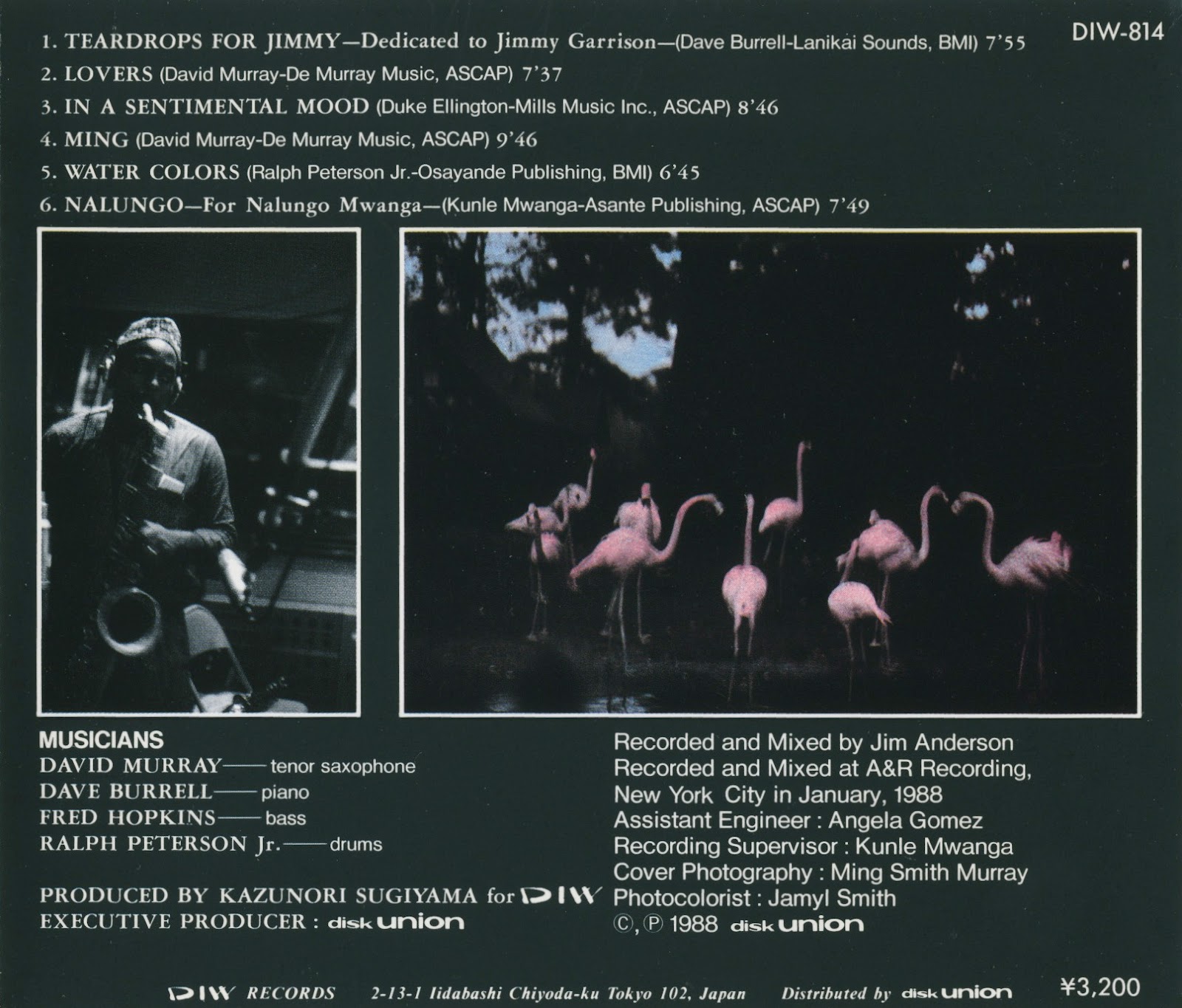
David Murray - Lovers


barabara sounds sez:
David Murray laid down not four but five [see comments] albums with the same band in the same series of sessions in New York in January 1988 for the Disk Union (DIW) label. This was the second of them — the others were Deep River, Spirituals, Ballads and Tenors — and probably the most overlooked. 
AMG likes Spirituals best — maybe because it's the least 'out there'. It also rates Ballards but doesn't even bother to write up Lovers. There's very little else out there on the web about these albums either, but the review of Ballards pretty much sums this one up too. As the man sez, these were some of his best albums of the decade. Excellent sound quality too. 

amg (Stephen Cook) sez:
Ballards is oneof David Murray's finest records. Like the three [sic] other excellent DIW releases that came from the same productive New York Sessions of January 1988 (Spirituals, Deep River, and Lovers), it contains a mix of originals by Murray, pianist Dave Burrell and drummer Ralph Peterson Jr., and it also includes fine bass work by Fred Hopkins. The rapport these players have on this record is stunning. They effortlessly move through a program of cool yet smart after-hours explorations that, in spite of the multi-layered arrangements, come out sounding almost artless... Murray displays his usual inventiveness of phrasing and tone... but thankfully suppresses his penchant for gratuitous outbursts, keeping his solos flowing. This sort of studied, yet loose playing is heard from all the quartet members, including Peterson, who, like Murray, also has the tendency to eat up the scenery...

Aug 7, 2011

Mal Waldron Trio - Spring in Prague + No More Tears for Lady Day

barabara sounds sez:  
More Mal – in fact a double-header, both featuring his trio with John Betsch and Paulo Carduso, both recorded in Germany and issued in Japan on the Alfa label.

No More Tears (recorded Nov.'88) is all mellow and introspective, like Mal is still feeling the grief all those years later. Whereas Spring in Prague (Feb.'90) is infused with much more vigor, reflecting the upheaval that had been going on in Eastern Europe in the previous year. Check out 'We demand' and 'Let us live': these are strong statements. In contrast, the title track is softer, an elegy no doubt looking back at the events in Czechoslovakia in 1968.

Apart from the allmusic review of No More Tears, there's very little out there about either of these albums – such as whether No More Tears came out first on Alfa or Timeless – so if anyone has any info, let's hear from you.

allmusic (Steve Loewy) sez:  
Not to be confused with the trio session recorded in the early '70s, Blues for Lady Day, this recording takes the same familiar trio format to revisit several tunes associated with Billie Holiday, as well as a few written in her memory by Waldron. The pianist is in a somber mood, perhaps because of the theme, though his performance is up to his usually high standards. A master of understatement, Waldron favors lingering chords that hang laconically even with the faster tempos. He rarely inserts an unneeded note, but instead concentrates on total sound. Drummer John Betsch brings out the best in each tune, pushing Waldron when appropriate. Bassist Paulo Cardoso makes little impression, particularly as a soloist, where he sometimes appears trapped by the structures of the songs. He is more successful as an accompanist. The delightful ambience of the trio results in a laid-back atmosphere that soothes and calms. A fine antidote to a stressful world and a lovely tribute to Lady Day.


Jul 24, 2011

TBM triple whammy


barabara sounds sez:
If you've got off on some of the recent j-jazz gems I've posted in recent weeks, then you're going to love the latest post over at Orgy in Rhythm. It's a triple helping of rare 70s sides from the legendary Japanese record label, Three Blind Mice.

All three are highly recommended — especially the rare Fukumura Quintet album.


Jul 12, 2011

Isao Suzuki Trio - Black Orpheus

barabara sounds sez:
Sukuki is one of the j-jazz greats — and this is one of his top sessions, laid down for the TBM label in 1976. The album title is a bit of a red herring, since the only music from Black Orpheus is the first track, the classic
Manha De Carnaval. That's also the standout track — but the whole of the album grooves very nicely too, thanks to Yamamoto's nifty keyboard work, especially on the Rhodes, with Donald Bailey anchoring everything most effectively.

someone else (can't remember where I found this) sez:
Isao Suzuki is one of the most important recording artists on the TBM label. Until his last album “Touch!”, he usually recorded with Kazumi Watanabe on guitar and his old friend Kunihiko Sugano on piano. However, he thinks highly of Tsuyoshi Yamamoto on piano and at a joint concert with Kenny Burrell, Suzuki asked Yamamoto to join him. Yamamoto’s powerful technique and taste for swing are a good match for Suzuki.

While Donald Bailey is a really exciting drummer. Donald grew up in Philadelphia and has amassed a lot of experience, including playing with top organist Jimmy Smith for nearly eight years. Unique in his drums setting is that his snare is fixed extremely oblique and tom-toms were fixed close to the snare. In addition, various bells and chimes are usually hung up. His favorite style is jazz mixed with latin beat. His simple but exciting jazz beat is very attractive and influential in the group.

musicians:
Suzuki
Isao
bass & cello; Yamamoto
Tsuyoshi
piano & electric piano; Donald Bailey drums

tracks:
Manha De Carnaval; Angel Eyes; Who Can I Turn To; In a Sentimantal Mood; Blues

tbm-63 recorded in Tokyo, Feb.20 1976