Nov 28, 2011
Archie Shepp - Ballads for Trane
barabara sounds sez:
I've been on a bit of a Shepp jag recently, and this is one that's been on regular late-night rotation here at chateau barabara. Laid down in 1977 for the Denon label, it's pretty short — less then 40 minutes in all — but oh so sweet, full of those intense, breathy notes Shepp plays so well. This is not the fire music he was playing a decade or so earlier. Check out the opening track, Mal Evans' Soul Eyes, and the one Trane track on this date, a classic take on Wise One. As far as I know, this was never issued outside Japan, and the original album now commands a fair old price — and there's a premium on the CD too these days.
an amazon review sez:
Just happened to listen to this right after "Four for Trane". A stark contrast to that CD, this REALLY IS a series of ballads performed beautifully by Mr. Shepp and his band. The feel of this album is what one would expect from a "ballads" compilation, but there is no lack of inspiration. The whole band remains focused throughout, and they put enormous effort into every phrase.
tracks:
1.Soul Eyes; 2.You Don't Know What Love Is; 3.Wise One; 4.Where Are You?; 5.Darn That Dream; 6.Theme For Ernie
personnel:
Archie Shepp (ts, ss); Albert Dailey (p); Reggie Workman (b); Charlie Persip (d)
Labels:
Albert Dailey,
Archie Shepp,
Charlie Persip,
Denon,
Reggie Workman
Nov 21, 2011
Sadik Hakim Trio - Witches, Goblins, etc.
barabara sounds sez:
It's a fantastic name for an album, strong cover art too. And if the music is slightly underwhelming — conventional is the word used by allmusic — there's still some lovely piano trio work to be found here.
Sadik Hakim is certainly no household name, leastways, not in the barabara bailiwick, and this SteepleChase side is the only album of his I've ever come across. So I've dropped a bit of background info at the bottom. Here's a potted version:
Hakim (birth name Argonne Thornton) was the legendary pianist who played with Charlie Parker (the 1954 KoKo session), Ben Webster, Dexter Gordon (Dexter Rides Again) and Lester Young (I'm Confessin'). In 1982, he played "'Round Midnight" at Thelonius Monk's funeral, a year before his own death.
allmusic.com sez:
Argonne Thornton (who in the late '40s changed his name to Sadik Hakim) had a particularly unusual boppish style in the '40s, playing dissonant lines, using repetition to build suspense, and certainly standing out from the many Bud Powell impressionists. Later in his career his playing became more conventional. Hakim originally studied music with his grandfather and started performing at local gigs in Minnesota. After a period in Chicago, he was heard by Ben Webster, who hired him to play with his group in New York (1944-1945). Hakim recorded with Webster and Dexter Gordon, was on part of Charlie Parker's famous "Ko Ko" session, and gigged regularly with Lester Young during 1946-1948, appearing on many recordings with Pres. After playing with Slam Stewart in 1949, in the 1950s Hakim worked fairly regularly with James Moody (1951-1954) and Buddy Tate's Orchestra (1956-1960) but never became too well known himself. Later in life he lived for a period in Montreal (the second half of the 1960s), performed in Europe often, and toured Japan (1979-1980). Other than sharing an album for the Charlie Parker label with fellow pianist Duke Jordan in 1962, Hakim did not record as a leader until 1973; during the next seven years he would lead dates for CBC, Japanese Progressive, SteepleChase, and finally in 1980 for Storyville.
musicians:
Sadik Hakim piano; Errol Walters bass; Al Foster drums
tracks:
1. Moon In Aquarius; 2. Witches, Goblins, etc; 3. Our Bossa Nova; 4. No More Sue; 5. Portrait Of Cousin Mickey; 6. Booger's Dilemma; 7. Peace Of Mind; 8. Say What You Mean; 9. Peace Of Mind; 10 Booger's Dilemma
And there's some interesting autobiographical stuff here at Tony Flood's House of Hard Bop — plus Tony's own recollections of meeting Hakim.
Nov 18, 2011
Michael Garrick 1933 - 2011
Sad news to hear of the passing of Michael Garrick — one of the greats of British jazz. Bacoso has posted a very fine appreciation of the man on the ever-essential Orgy in Rhythm — along with an excellent mix of Garrick's music by Black Classical.
RIP — and thanks for all that music!
Nov 6, 2011
Toshiko Akiyoshi / LewTabackin Big Band - Salted Gingko Nuts
barabara sounds sez:
Autumn's here: time for one of my favorite seasonal snacks. Great with beer, even better with sake, and perfect too with Toshiko's peerless big band music. This one (on Baystate from 1978) is particularly nutritious. It's a 16-piece aggregation, but they played together so much over the course of that decade that they sound like one seamless unit. There are also some great solos from Bobby Shew on trumpet and Gary Foster (alto). Tasty...
Yawno sez:
The Toshiko Akiyoshi-Lew Tabackin Orchestra's first few recordings were made for RCA (usually released first in Japan and then later in the U.S.) but, after that association ended in 1978, most of the big band's recordings ended up being released by their own private Ascent label. The orchestra (based in Los Angeles) was one of the finest big bands of the era, as can be heard on this superior outing with Akiyoshi on piano, Tabackin displaying very different styles on tenor and flute, altoists Gary Foster and Dick Spencer, and trumpeter Bobby Shew. The leader's arrangements reflect both her roots in swinging bop and her Asian heritage. Highlights of the excellent set are "Chasing After Love" (based on "Lover"), the lyrical "Elusive Dream," and "Son of Road Time."
There's lots more about Toshiko over here on Susan Fleet's web site.

Oct 26, 2011
Pharoah Sanders - Journey to the One + Rejoice
The great great Ferrell just finished the second of a two-night stand here. So, in honor and awe, here's a couple of his finest mid-period sides on the Theresa label. Rejoice is of course a bonafide barabara classic – just look and marvel at the outstanding line-up of musicians he has with him here – and without question cause for outright exultation.
As for Journey to the One, it's a bit of a cosmic cocktail of textures – from spiritual-jazz anthems and all-out trademark Pharoa-nics to ballads, and using koto, sitar, synths and more – but there are plenty of special moments here, not least the stately magnificent Bedria that closes out side 4. One of my favorites, in fact...
dusty sez (on Rejoice):
Fantastic 80s work from Pharoah Sanders – with a vibe that's a perfect extension of his classic work for the Impulse label! The album has Pharoah working with an amazing group – Bobby Hutcherson on vibes, John Hicks and Joe Bonner on piano, Art Davis on bass, and either Elvin Jones or Billy Higgins on drums. The sound is remarkably fresh – soaring and spiritual, but also more focused than in earlier years, with a great amount of soulful warmth. And although extra elements are added – like vocals, vibes, and added percussion – Pharoah's solos still dominate the whole album beautifully.
amg (Scott Yanow) sez (on Journey):
…all ten of Pharoah Sanders's performances from the sessions. As usual, Sanders shifts between spiritual peace and violent outbursts in his tenor solos. The backup group changes from track to track but often includes pianist John Hicks, bassist Ray Drummond and drummer Idris Muhammad. Sanders really recalls his former boss John Coltrane on "After the Rain" (taken as a duet with pianist Joe Bonner) and a romantic "Easy to Remember"; other highpoints include "You've Got to Have Freedom" (which has Bobby McFerrin as one of the background singers) and the exotic "Kazuko" on which Sanders is accompanied by koto, harmonium and wind chimes.
Oct 17, 2011
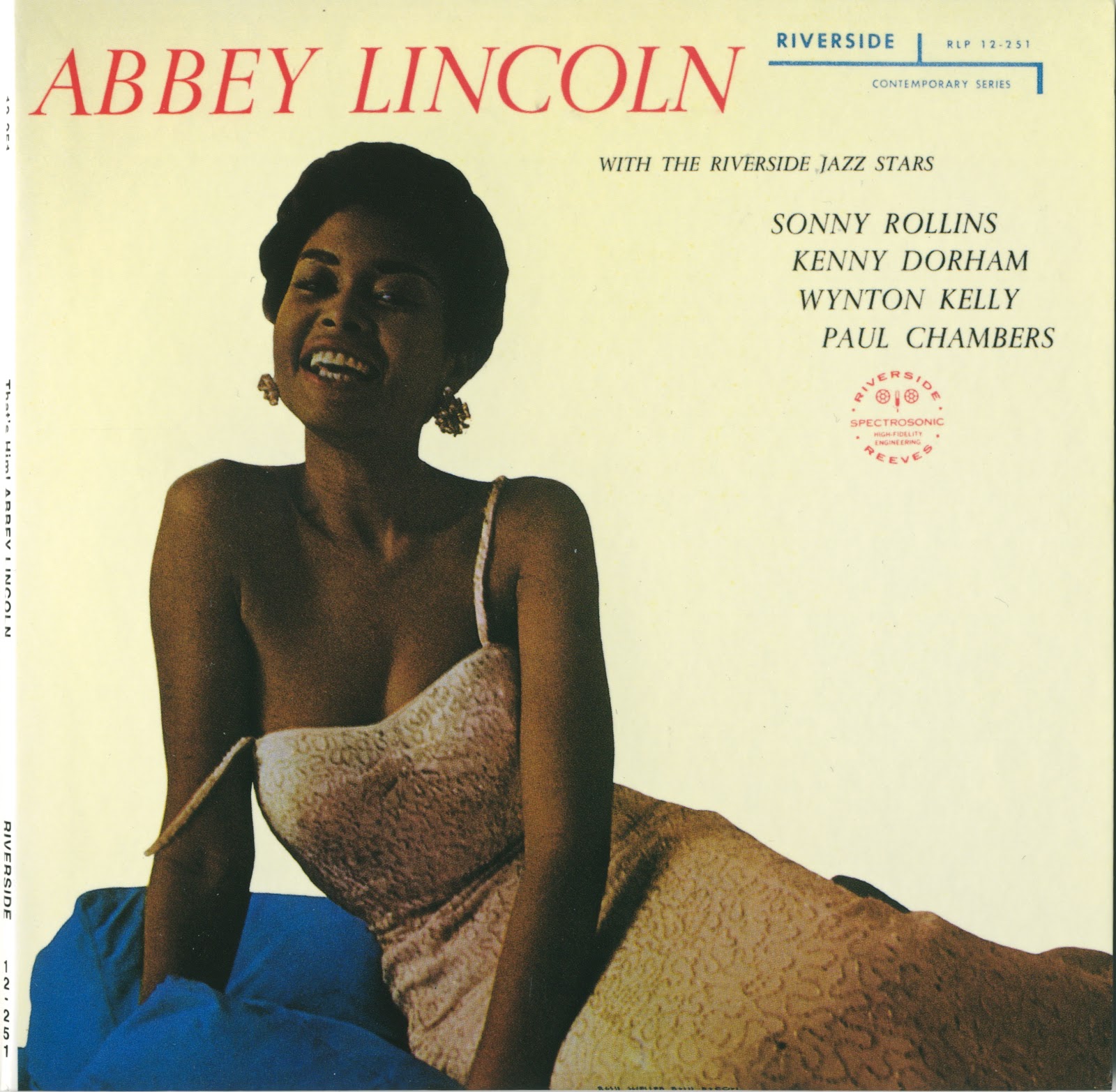
Abbey Lincoln - That's him!
barabara sounds sez:
Abbey's work from the 60s and on is probably better known, but this is a lovely early side notable for the stellar cast of musicians backing her, billed here as the Riverside Jazz Stars. I never heard Rollins sound so lyrical! At this point in her career the Billie Holiday comparisons are inevitable — but that's the finest kind of recommendation in my book.
cduniverse sez:
Abbey's first early peak [is] a wonderful and confident set with a stunning ensemble... Lincoln opens with Oscar Brown Jr.'s "Strong Man" — she was one of the performers who regularly recorded his songs prior to his own debut as a recording artist in the early '60s... The gorgeous and dramatic "Tender as a Rose" is presented acapella. Throughout, Lincoln's singing easily mingles jazz, blues and folk influences and phrasings. This strong album pointed the way to her ABBEY IS BLUE, her essential work recorded two years later.
AMG (Scott Yawno) sez:
[On] Abbey Lincoln's second recording and first for Riverside, [she] is accompanied by quite an all-star roster... and, even this early, she was already a major jazz singer with a style of her own. Lincoln was careful from this point on to only interpret lyrics that she believed in. Her repertoire has a few superior standards (including several songs such as "I Must Have That Man!" and "Don't Explain" that are closely associated with Billie Holiday) plus Oscar Brown, Jr.'s "Strong Man" and Phil Moore's "Tender as a Rose"; she takes the latter unaccompanied. "Don't Explain" is slightly unusual in that Paul Chambers is absent and Wynton Kelly makes an extremely rare appearance on bass.
personnel:
Abbey Lincoln vocals; Kenny Dorham trumpet; Sonny Rollins tenor saxophone; Wynton Kelly piano; Max Roach drums.
Labels:
Abbey Lincoln,
Kenny Dorham,
Max Roach,
Riverside,
Sonny Rollins,
vocal jazz,
Wynton Kelly
Oct 5, 2011
Dizzy Gillespie's Big 4 + Oscar Peterson & Dizzy Gillespie
barabara sounds sez:
I don't listen to bebop too much, never have.
It's probably a generation thing – it was already over and passe by the time I discovered it. And
I was probably taking the wrong drugs anyway. That said, I've always had lots of time for Dizzy, especially the Cuban connection, plus he was such a great showman, though I only caught him in the 70s. Though it was rather past the peak of his prime, he'd no way lost his amazing chops. Just check out the tempo of some of the tracks on this excellent side from 1974 on Pablo, especially the tour de force that is Bebop (Dizzy's FIngers) which opens side 2. Bravissimo!
It's probably a generation thing – it was already over and passe by the time I discovered it. And
I was probably taking the wrong drugs anyway. That said, I've always had lots of time for Dizzy, especially the Cuban connection, plus he was such a great showman, though I only caught him in the 70s. Though it was rather past the peak of his prime, he'd no way lost his amazing chops. Just check out the tempo of some of the tracks on this excellent side from 1974 on Pablo, especially the tour de force that is Bebop (Dizzy's FIngers) which opens side 2. Bravissimo!
And then there was the album he recorded the same year in London with Oscar Peterson, also for Pablo. The pianist got the top billing (it was part of a series of duo sessions with trumpeters he did for the label). But there's no way Dizzy takes second place here. Just the one track this time, but it's a classic: you just can't beat it!
someone else (unattributed) sez [on DG Big 4]:
…superb production values, dynamic acoustic sound, and generally provocative mix of players and musical materials. Dizzy's Big 4 is one of the very best, featuring a dream team rhythm section that responds to all of Gillespie's virtuoso challenges, and then some. Ray Brown is one of the all-time greats, who startled the jazz world when he first emerged as Dizzy's bassist while still in his teens; drummer Mickey Roker is a commanding percussionist and long-time Gillespie collaborator, while guitarist Joe Pass is a stellar virtuoso, with a series of excellent recitals of his own on Pablo.
Gillespie is in a particularly puckish mood on these sessions. Where the youthful Gillespie might have ordinarily opted for more of the bravura pyrotechnics, represented here by the relentlessly uptempo changes of "Be Bop (Dizzy's Fingers)", Dizzy's Big 4 is distinguished by the ballads "Hurry Home," "Russian Lullaby" and "September Song." Here the trumpeter's rich timbral shadings plumb deep new meaning from these familiar melodies. Most impressive is Dizzy's depth and range as a blues player, which further enlivens his improvisations on Fats Waller's "Jitterbug Waltz," his own latin styled funk on "Frelimo" and the hard bopping "Birks Works."
jazz.com (Mark Longman) sez [on OC&DG]:
On Gillespie's second recording for Norman Granz's Pablo label, he joins Oscar Peterson for a set of miraculous duets. Benny Green, who wrote the liner notes for this album, compared this performance of Ellington's classic composition to the Armstrong and Hines rendition of "Weather Bird." Peterson melds a keen sense for complementary accompaniment with dexterous, interweaving polyphonic lines. The breakneck tempo does little to deter Gillespie, who navigates an unaccompanied section without wavering in the slightest. Both musicians bring their best to this date: both show incredible range, flexibility, and complete mastery of their instruments. The result is a well-worn standard transformed through harmonic freshness and rhythmic vitality into an iconic performance.
Labels:
Dizzy Gillespie,
Joe Pass,
Mickey Roker,
Oscar Peterson,
Pablo,
Ray Brown
Subscribe to:
Posts (Atom)