Feb 23, 2011

Kalaparusha - Kwanza

barabara sounds sez:

The one and only Kalaparusha, free and fiery, on Baystate from '77 (to be precise, recorded in NYC in M
ay 9, 1977)
. This little number goes for substantial bucks for the original album, and even the reissue — which this is ripped from — is hard to get hold of now. W
hich is why the scans, including the art above, still have the obi and shrink wrap on.

what my original post said:

I had this post all ready to go up for a couple of weeks. But while I dallied (out of town actually), it has now been posted over at the excellent Inconstant Sol, so I didn't bother. Instead, head over there to pick it up — and check out the comments, including a link to a film about where Kalaparushi Maurice McIntyre is at right now (and it ain't a good place).


But enough time has elapsed, so this has been reinstated as a full-fledged barabara sounds post. Too good not to share :-)


tracks:

Kwanza; Leo; Buumba; Around We Go


personnel:

Kalaparusha: tenor sax & clarinet

Malachi Thompson: trumpet

Hakim Jami: bass

John Betsch: drums

Juma Sultan: congas & percussions


Feb 20, 2011

Don Friedman - Circle Waltz

barabara sounds sez:
I recently dusted this gem off again and was reminded h
ow excellent it is. Friedman's bad luck was to follow and forever be in the shadow of Bill Evans. But this set on Riverside was well received over this side of the pond (it got a record of the year award here back in 1962), and he still visits from time to time. With Israels and LaRoca backing him — apart from one solo track (So In Love) — it really is an underappreciated overlooked gem. I'm obviously not the only one either: the amazon review below really revs it up (while inevitably Yawno damns it with faint praise).

dusty sez:
A great little set from Friedman – a vastly underrated pianist who's working here as a bright young modernist in a trio with Chuck Israels on bass and Pete LaRoca on drums. The tracks have a freedom that reminds us a lot of Bill Evans' early work, with a warm lyricism that never gets too hokey – yet isn't afraid to show itself in Friedman's original compositions.

an amazon customer sez:
If Evans is Matisse, Don Friedman is Kandinsky. The album is nearly uniform in its intensity and inventiveness, but the title track, Circle Waltz, stands out. Compare it to Evans' Gloria's Step and Re: Someone I Know. All these songs seem to paint a picture of the city and modernity that a jazz piano alone could have captured.

AMG (scott yawno) sez:
Even ignoring that bassist Chuck Israels is on this set and the similarity of some of the repertoire, it is difficult to overlook the fact that pianist Don Friedman sounds very similar to Bill Evans. With drummer Pete LaRoca completing the trio and such songs as "I Hear a Rhapsody," "In Your Own Sweet Way" and "So In Love" joining four of the leader's originals, Friedman uses chord voicings similar to Evans and engages in the same type of close interplay with his sidemen.

tracks:
Circle Waltz;
Sea's Breeze; I Hear A Rhapsody; In Your Own Sweet Way; Loves Parting; So In Love; Modes Pivoting

personnel:
Don Friedman piano; Chuck Israels bass; Pete La Roca drums.

Feb 15, 2011

Yosuke Yamashita - Spider

barabara sounds sez:
Staying close to home, and more from the superb Yosuke Yamashita. Spider is one of six (I believe) he made with his New York Trio, which comprised him plus the great Cecil McBee and Pheeroan akLaff. They began playing together in 1988, and so by the time this fine set was laid down (in NYC, in June '95) they'd built up a really good understanding.

The trio are in top form from the get-go. and there's some great playing. One of the stand-outs for me is One for M, but the title track, at the very end, is also a blast.

tracks:
Cats Dance; Revenge Of Picasso; One For M; Quiet Days; Fourth Step; Kids In Memory;Doubles; Stream; Spider

The other feature of this album is the cool spider-themed artwork — full scans of the CD inserts included!

Looking for more Yamashita? Then check out the comprehensive discography over on the indispensible — but currently dormant — El Goog Ja, here... Unfortunately most of the RS links are extinct, but it'll give you an idea of what to look out for. Expect a few more posts in the future here...

Feb 7, 2011

Togashi-Yamashita Duo - Kizashi

barabara sounds sez:
Here's another duo out of Japan, but this time featuring piano and drums/percussion. Neither Yosuke Yamashita or Masahiko Togashi should need introduction — they're among the greats from the golden age of Japanese jazz and improvisation. This session laid down in 1980 is short (just 38 minutes) but very sweet, with some lovely inventive playing. And that is probably why this has gone through a couple of CD reissues (this rip is from the first ie non SHMCD) though currently OOP. The duo also recorded a live concert of the same material later the same year.

Kizashi [ 兆 ] means a sprout or bud, but can also mean a sign or omen — not in a mystical sense but apparently as a premonition of the future direction of jazz in Japan. Looking back, I'm not sure that means very much. But at the time it was exciting, the final fling of that golden age.

Jan 25, 2011

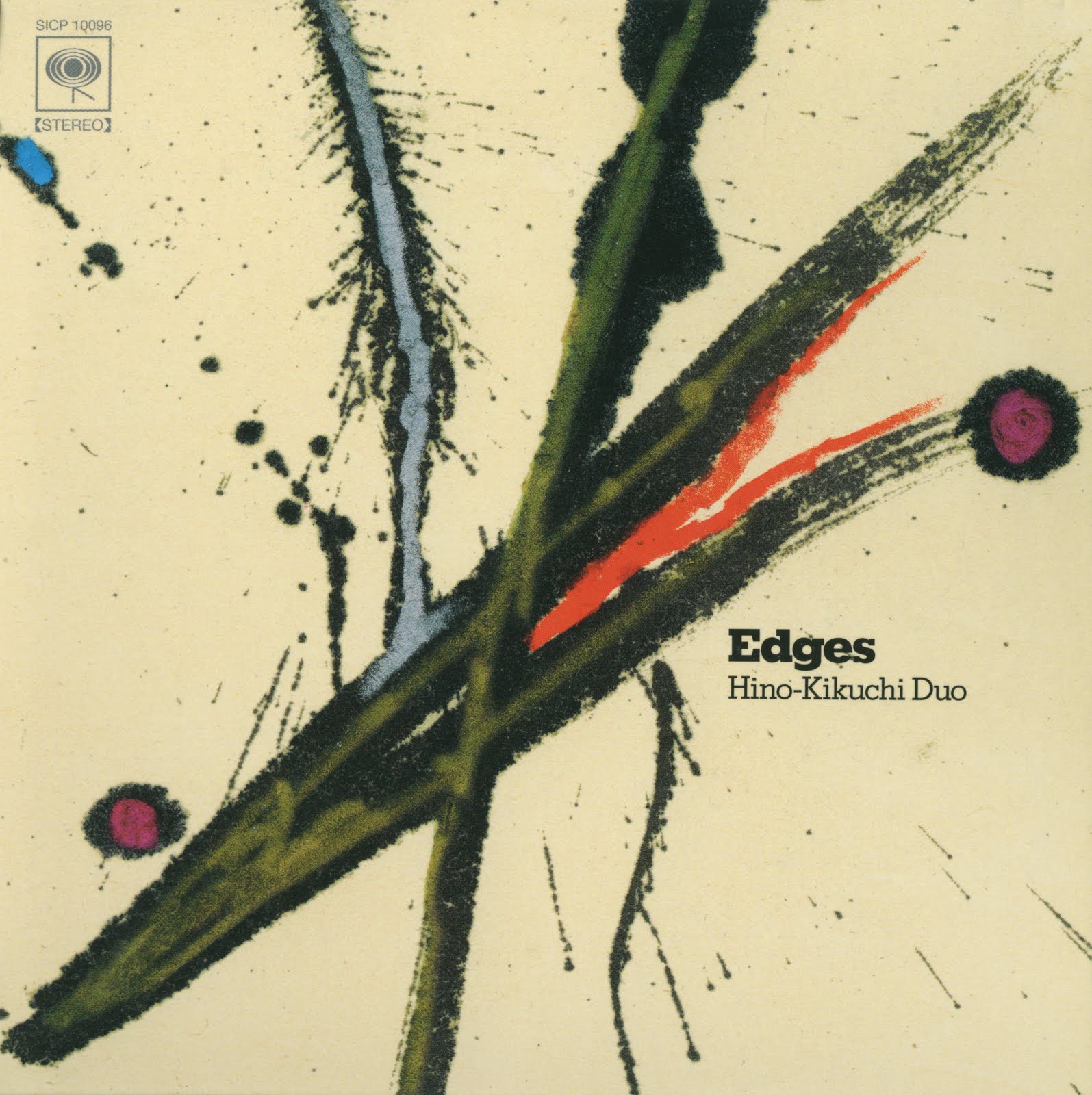
Hino-Kikuchi Duo - Edges

barabara sounds sez:
It's about time I posted this, the companion piece to my earlier post (back in November) of Counter Current. I'm not sure why I've held it back till now. Maybe because it's sparer, less 'straightforward' — I'm tempted to say edgy, but that would give the wrong impression — it demands more attention and grabs you in a rather different place. But it's not because I like it any less.

Even though it was recorded during the same sessions as Counter Current, this is a very different album. As you can tell, it's just the two of them, Terumasa Hino and Masabumi Kikuchi, just trumpet and piano, sometimes together other times exploring out there on their own. Curiously, the cover art is in bold color, whereas the sleeve for Counter Current is sumi ink on washi white — but Edges is by far the more monochromatic in its soundscapes. Here's a nice review from All About Jazz, says it better than I can...

AAJ (Andrey Henkin) sez:
The similarities between two new releases by Japanese legends Terumasa Hino and Masabumi Kikuchi are obvious. Both were recorded within the same two weeks at the same studio. Both share broadly painted abstract covers on their appealing LP-style gatefold sleeves. Both are mostly originals by the pair, including two versions of two pieces book ending each disc. Even the aesthetics, despite the first being a duet and the other a quintet, have something in common. Palpably companion pieces, for all their similarities, these are distinct albums. But one thing they both contain is possibly the most surprising. Though continuing a partnership begun decades ago, the albums don't demonstrate an expected easy comfort; that is their strength.

Edges is an uncommon duet between an unusual pairing. Piano and trumpet inhabit a similar tonal range so any counterpoint is of a subtler breed. The eight pieces, including the two takes of the title track that begin and end the album, are aural representations of the album artwork: painted in bold expressionistic strokes. What is fascinating though is the tangible sense of tension. When one listens to a duet, breezy dialogue or spirited agreements are usually the expectation. Hino and Kikuchi are obviously old friends but ones who seem to have little in common. When their careers began, they were closer in spirit; the intervening years have separated them. They are like adults who are friends because they grew up next to each other. This turns Edges into a session whose appeal is in its agitation. Each author has his pieces dominated by the other musician and the solo pieces are almost exhalations. "I Fall In Love Too Easily," the album's only standard, exemplifies this ironic relationship.

personnel:
Terumasa Hino: trumpet; Masabumi Kikuchi: piano.

tracks:
Edges (ver. 1); Is It?; Alone, Alone And Alone; Can't Describe; I Fall In Love Too Easily; Dad, I Miss You (trumpet solo); My Kinda Yesterday (piano solo);
Edges (ver. 2)


Jan 13, 2011

Hidefumi Toki & The Super Jazz Trio - City-Toki

barabara sounds sez:
Hidefumi Toki burst onto the scene back in the early 70s as the sax player in Toshiyuki Miyama's New Herd — in fact I was reminded of this album by Katonah's great recent post of Sunday Thing over on his always essential Private Press [even though Toki didn't actually play on that one]. Before long Toki was leading his own unit, and by the time City-Toki came out in 1978 he was just about at the top of his game. Most of what came next is not really worth exhuming — a sad decline into fuzak and session wilderness. But on this album, cut in NYC, he certainly shows he has the chops to hold his own with a rhythm section of the quality of Flanagan, Workman and Chambers. He's also come up with some nice compositions. I can't say it's absolutely all killer [to quote a line] but it's definitely more than just filler.

Recorded July 6 1978 at Sound Ideas Studio NYC; issued on Baystate; this is ripped from the 2005 JP-only CD reissue.

personnel:
Hidefumi Toki alto sax, soprano sax; Tommy Flanagan piano; Reggie Workman bass; Joe Chambers drums

There's a [not totally complete] Toki discography here...

Jan 3, 2011

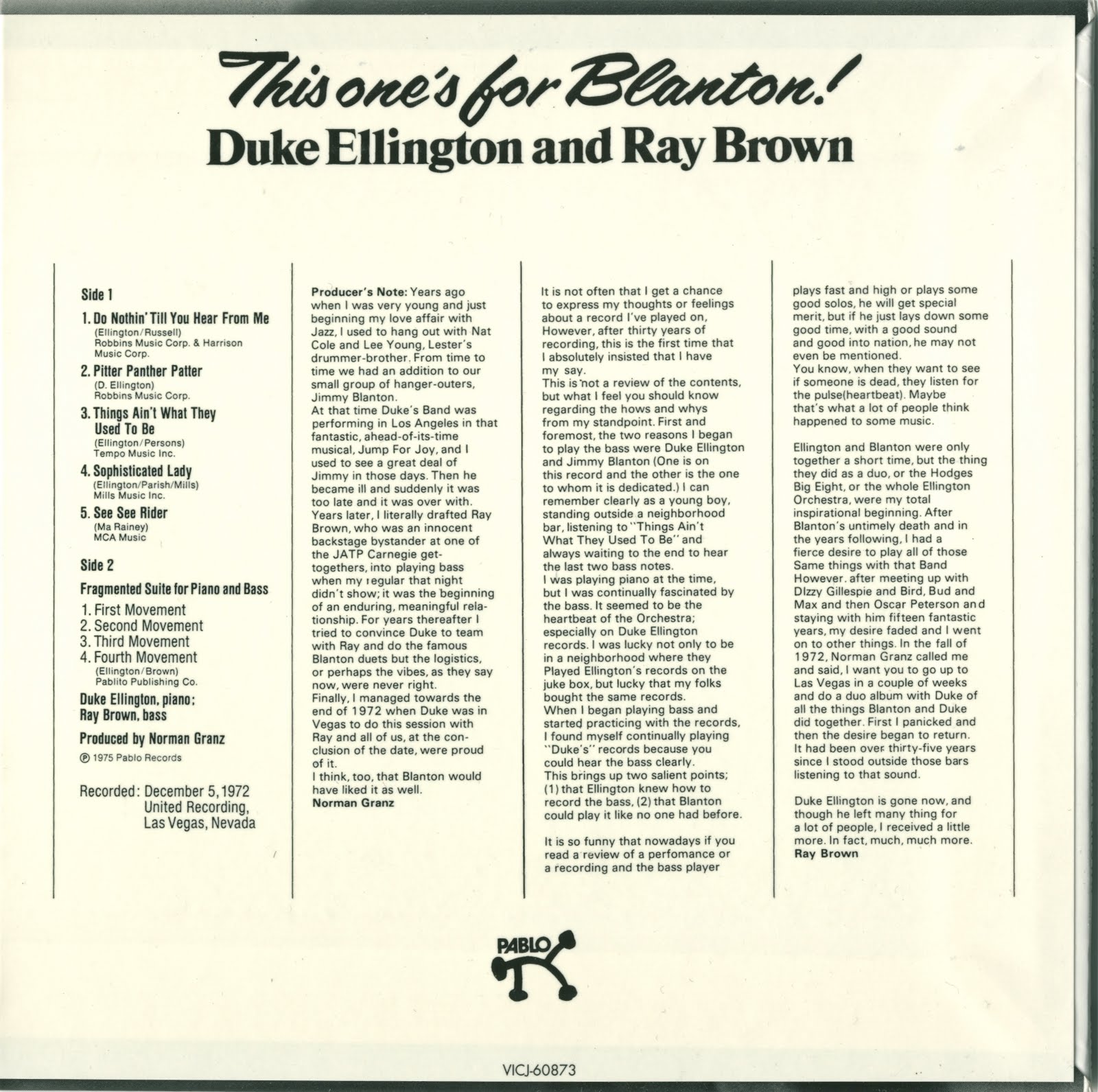
Duke Ellington and Ray Brown - This one's for Blanton!

barabara sounds sez:
It doesn't get much simpler than this: just piano and bass. But there is so much music here, with Ellington and Brown just hitting the perfect groove. I love the de/reconstructed See See Rider. But it's the second side that really does it for me, the four-part Fragmented Suite for Piano and bass. This was just about the last session Duke ever recorded. And I've got to say, it's one of the most beautiful I've ever heard of his. Not that I've heard them all — in fact one of my new year resolutions is to listen to a lot more of the older albums Ellington did in the 50s and beyond. This is from the JP reissue of the Pablo album, and it's a bona fide barabara classic.

From the sleeve notes by Ray Brown:
Ellington and Blanton were only together a short time, but the thing they did as a duo, or as the Hodges Big Eight, or the whole Ellington Orchestra, were my total inspirational beginning. After Blanton's untimely death and in the years following, I had a fierce desire to play all of those same things with that band. However... I went on to other things. In the fall of 1972, Norman Granz called me and said, I want you to go up to Las Vegas in a couple of weeks and do a duo album with Duke of all the things that Blanton and Duke did together. First I panicked and then the desire began to return. It had been over thirty-five years since I stood outside those bars listening to that sound. Duke Ellington is gone now, and though he left many things for a lot of people, I received a little more. In fact, much much more.

When he died in 1942, Duke Ellington’s 21-year-old bassist, Jimmy Blanton, had liberated the string bass from its traditional role as an accompanist. Two of Blanton’s disciples, Ray Brown and Oscar Pettiford, carried forward his work of developing the bass into a solo instrument. Their contributions had a great deal to do with bebop’s becoming a mature music. More than 30 years after Blanton’s death, Brown went into a studio with Ellington to pay homage to his idol. Their duets echo the famous ones of Ellington and Blanton and demonstrate Brown’s creativity and virtuosity on the Blanton model.

If you like this, then check out Reza's post of the Ellington suites, also on Pablo... highly recommended!